Question
An element has number of electrons  = 2. Then what will be its atomic number?.

Answer

  1. 2
Explanation:
Atomic number of any element is equal to number of protons or number of electrons.
Atomic no = no of proton  = no of electron.

Need a full question paper?

Generate a complete, print-ready paper with questions like this in minutes — across 16+ boards, with answer keys.
Start Generating Free

Similar questions

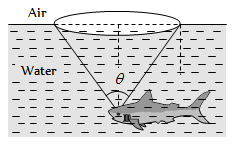
A fish is a little away below the surface of a lake. If the critical angle is $49^\circ ,$ then the fish could see things above the water surface within an angular range of $\theta ^\circ $ where
Two point charges Q  and – 3Q are placed at some distance apart. If the electric field at the location of Q is E then at the locality of -3Q, it is(a) - E (b) E/3(c) -3E (d) -E/3
       
Which one of the following nuclear reactions is a source of energy in the sun
Which of the following is not a point of similarity between Biot-Savart law and Coulomb’s law.
Cathode rays travelling from east to west enter into region of electric field directed towards north to south in the plane of paper. The deflection of cathode rays is towards(a) East   (b) South(c) West (d) North
       
Taking the Bohr radius as $a_0 = 53\ pm,$ the radius of $Li^{++} $ ion in its ground state, on the basis of Bohr’s model, will be about:
A particle of charge $q$ and mass $m$ moving with a velocity $v$ along the $x-$axis enters the region $x>0$ with uniform magnetic field $B$ along the $\hat{\mathrm{k}}$ direction. The particle will penetrate in this region in the $x-$direction upto a distance $d$ equal to
The outer sphere of a spherical air capacitor is earthed. For increasing its capacitance(a) Vacuum is created between two spheres(b) Dielectric material is filled between the two spheres(c) The space between two spheres is increased(d) The earthing of the outer sphere is removed


Statement(A): Negative charges always move from a higher potential to lower potential point
Statement (B): Electric potential is vector.
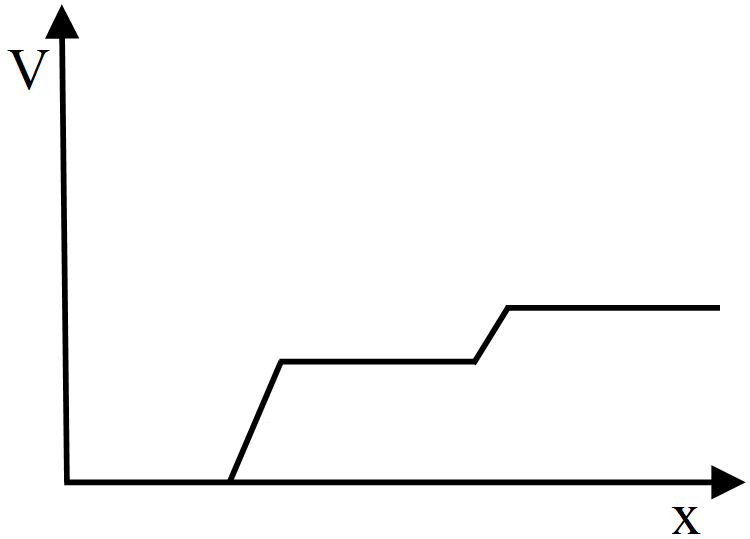
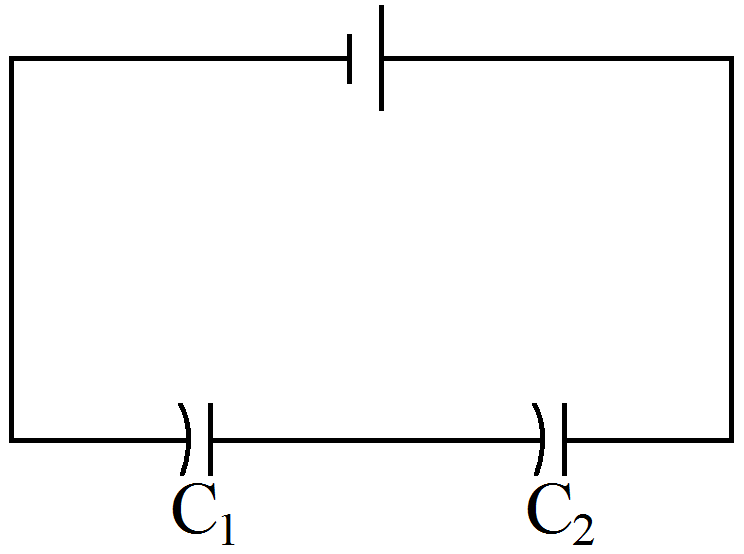
Figure shows two capacitors connected in series and joined to a battery. The graph shows the variation in potential as one moves from left to right on the branch containing the capacitors: