MCQ
An element has the electronic configuration $1{s^2},2{s^2}2{p^6},3{s^2}3{p^2}$. Its valency electrons are
  • A
    $6$
  • B
    $2$
  • C
    $3$
  • $4$

Answer

Correct option: D.
$4$
d
(d) An element has the electronic configuration $1{s^2},\,2{s^2}\,2{p^6},\,\,3{s^2}\,3{p^2},\,(Si)$. It’s valency electrons are four.

Need a full question paper?

Generate a complete, print-ready paper with questions like this in minutes — across 16+ boards, with answer keys.

Start Generating Free

Similar questions

Which of the following pairs of d-orbitals have electron density along the axis?
What is the minimum concentration of $SO_4^{2 - }$ required to precipitate $BaS{O_4}$ in a solution containing $1.0 \times {10^{ - 4}}\,mol\,\,\,B{a^{2 + }}$ (${K_{sp}}$ for $BaS{O_4}$ is $4 \times {10^{ - 10}}$)
$200\, \mathrm{~mL}$ of $0.2\, \mathrm{M} \mathrm{HCl}$ is mixed with $300\, \mathrm{~mL}$ of $0.1\, \mathrm{M} \mathrm{NaOH}$. The molar heat of neutralization of this reaction is $-57.1 \,\mathrm{~kJ}$. The increase in temperature in ${ }^{\circ} \mathrm{C}$ of the system on mixing is $\mathrm{x} \times 10^{-2}$. The value of $\mathrm{x}$ is ....... . (Nearest integer)

[Given : Specific heat of water $=4.18\, \mathrm{~J} \,\mathrm{~g}^{-1}\, \mathrm{~K}^{-1}$

Density of water $=1.00\, \mathrm{~g}\, \mathrm{~cm}^{-3}$ ]

(Assume no volume change on mixing)

One among the following is the correct $IUPAC$ name of the compound 

$\begin{array}{*{20}{c}}
  {\,\,\,\,\,H} \\ 
  {\,\,\,\,\,\,|} \\ 
  {C{H_3}C{H_2} - N - CHO} 
\end{array}$

Elements having atomic number $33, 47, 53, 59, 68, 74, 82$ are present in
The lattice energies of $KF, KCl, KBr$ and $KI$ follow the order
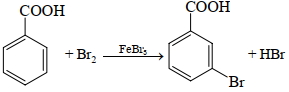
Consider the above reaction where $6.1 \,g$ of benzoic acid is used to get $7.8\, g$ of $m$ -bromo benzoic acid. The percentage yield of the product is ....... .

(Round off to the Nearest integer) [Given : Atomic masses : $C =12.0 \,u , H : 1.0\, u,O : 16.0 \,u , Br =80.0 \,u ]$
When $Z$ is doubled in an atom, which of the following statements are consistent with  Bohr's theory?
Possible alkyl radicals formed by $C _4 H _9$ is :
Propane is obtained from propene, by which of the following methods