Question
An element with molar mass $27\ g\ mol^{–1}$ forms a cubic unit cell with edge length $ 4.05 \times 10^{–8}\ cm$. If its density is $2.7\ g\ cm^{–3}$, what is the nature of the cubic unit cell?

Answer

$\text{d}=\frac{\text{z}\times\text{M}}{\text{a}^{3}\text{N}_{A}}$
$\text{z}=\frac{\text{d a}^{3}\text{N}_{A}}{\text{M}}$
$\text{z}=\frac{\text{2.7g cm}^{-3}\times\text{6.022}\times\text{10}^{23}\text{mol}^{-1}\times\text{(4.05}\times\text{10}^{-8}\text{cm)}^{3}}{\text{27 g mol}^{-1}}$
$=3.999 \approx 4$
Face centered cubic cell/fcc.

Need a full question paper?

Generate a complete, print-ready paper with questions like this in minutes — across 16+ boards, with answer keys.
Start Generating Free

Similar questions

Arrange the following in increasing order of their basic strength.
(ii) $\left.C _6 H _5 NH _2, C _6 H _5 N_{\left( CH _3\right.}\right)_2,\left( C _2 H _5\right)_2 NH$

(ii) Aniline, p -nitro aniline, p -toluidine
(iii) $C _6 H _5 NH _2, \quad C _6 H _5 NHCH _3, \quad C _6 H _5 CH _2 NH _2$
An element crystallizes in a f.c.c. lattice with cell edge of $250$ pm. Calculate the density if 300 g of this element contain $2\times 10^{24}$ atoms.
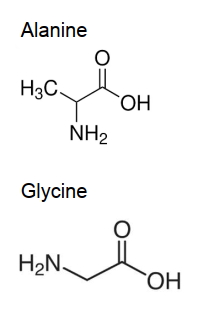
a. Give the structure of all the possible dipeptides formed when the following two amino acids form a peptide bond.
Image
b. Keratin, insulin, and myosin are a few examples of proteins present in the human body. Identify which type of protein is keratin and insulin and differentiate between them based on their physical properties.
An organic compound A has the molecular formula $C_8H_{16}O_8$​​​​​​​. It gets hydrolysed with dilute sulphuric acid and gives a carboxylic acid B and an alcohol C. Oxidation of C with chromic acid also produced B. C on dehydration reaction gives but-1-ene. Write equations for the reactions involved.
$A\ 4 \%$ solution $(\mathrm{w} / \mathrm{w})$ of sucrose $\left(\mathrm{M}=342 \mathrm{~g} \mathrm{~mol}^{-1}\right)$ in water has a freezing point of $271.15$ K . Calculate the freezing point of $5 \%$ glucose $\left(\mathrm{M}=180 \mathrm{~g} \mathrm{~mol}^{-1}\right)$ in water.
$($Given: Freezing point of pure water $=273.15 \mathrm{~K} )$
Give the structures and IUPAC names of the products expected from the following reactions:
a. Catalytic reduction of butanol.
b. Hydration of propene in the presence of dilute sulphuric acid.
c. Reaction of propanone with methyl magnesium bromide followed by hydrolysis.
Why Haloarenes undergo electrophilic substitution reactions at o and p - position? Why it is less reactive than benzene ?
What is the significance of leaching in the extraction of aluminium?
  1. Explain the following giving suitable examples:
  1. Sandmeyer’s reaction.
  2. Coupling reaction of a diazonium salt.
  1. Explain the observed $K_b$ order:
$Et_2NH>Et_3N>EtNH_2$ in aqueous solution.
(i) Give the structure of haloalkane having five carbon by which optical isomerism is shown.
(ii) Which type of isomerism is present in 1-chloro butane and 1-chloro-2-methyl propane.
(iii) Write the position isomers of the compound having molecular formula $C _4 H _9 Cl$, which have straight chain.