Question
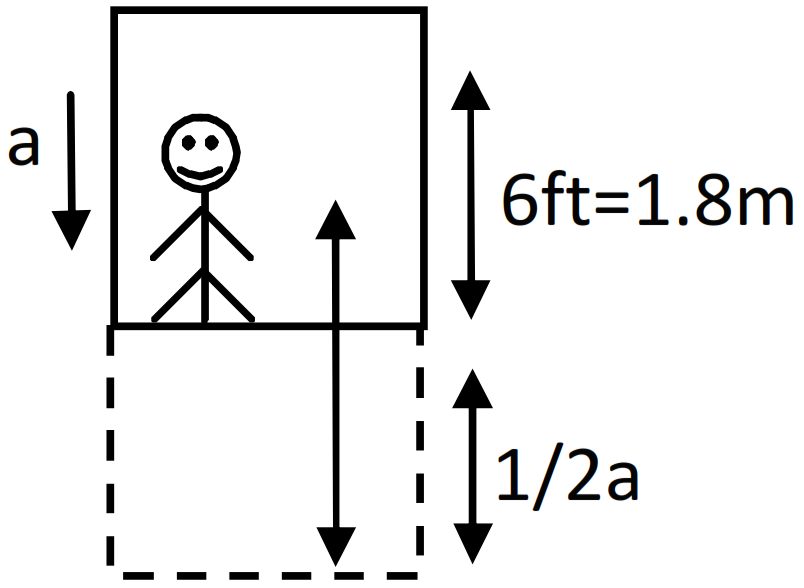
An elevator is descending with uniform acceleration. To measure the acceleration, a person in the elevator drops a coin at the moment the elevator starts. The coin is 6ft above the floor of the elevator at the time it is dropped. The person observes that the coin strikes the floor in 1 second. Calculate from these data the acceleration of the elevator.

Answer

For elevator and coin u = 0

As the elevator descends downward with acceleration a' (say)

The coin has to move more distance than 1.8m to strike the floor. Time taken t = 1 sec.

$\text{S}_{\text{c}}=\text{ut}+\frac{1}{2}\text{a}'\text{t}^2=0+\frac{1}{2}\text{g}(1)^2=\frac{1}{2}\text{g}$

$\text{S}_{\text{e}}=\text{ut}+\frac{1}{2}\text{at}^2=\text{u}+\frac{1}{2}\text{a}(1)^2=\frac{1}{2}\text{a}$

Total distance covered by coin is given by $=1.8+\frac{1}{2}\text{a}=\frac{1}{2}\text{g}$

$\Rightarrow1.8+\frac{\text{a}}{2}=\frac{9.8}{2}=4.9$

$\Rightarrow\text{a}=6.2\text{m/s}^2=6.2\times3.28=20.34\text{ft/s}^2.$

Need a full question paper?

Generate a complete, print-ready paper with questions like this in minutes — across 16+ boards, with answer keys.

Start Generating Free

Similar questions

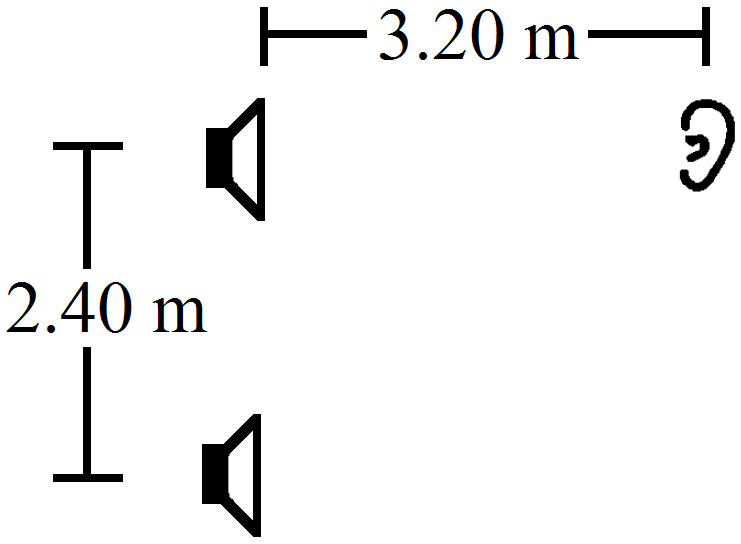
Two stereo speakers are separated by a distance of 2.40m. A person stands at a distance of 3.20m directly in front of one of the speakers as shown in figure, Find the frequencies in the audible range (20-2000Hz) for which the listener will hear a minimum sound intensity. Speed of sound in air = 320m/s.

Why don't we have interference when two candles are placed close to each other and the intensity is seen at a distant screen? What happens if the candles are replaced by laser sources?
The power averaged over one full cycle of a.c. is known as average power. It is also known as true power.
$\text{P}_\text{av}=\text{V}_\text{rms}\text{I}_\text{rms}\cos\phi=\frac{\text{V}_0\text{I}_0}{2}\cos\phi$
Root mean square or simply rms watts refer to continuous power.
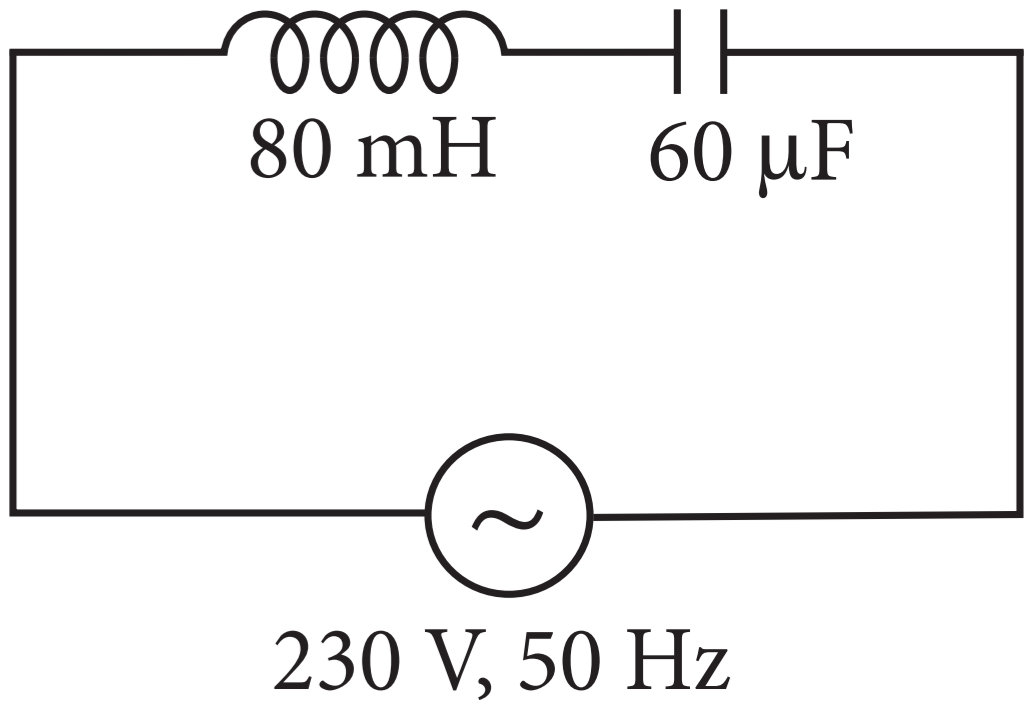
A circuit containing a 80mH inductor and a $60\mu\text{F}$ capacitor in series is connected to a 230V, 50Hz supply. The resistance of the circuit is negligible.

  1. The value of current amplitude is:
  1. 15A
  2. 11.63A
  3. 17.65A
  4. 6.33A
  1. Find rms value.
  1. 6A
  2. 5.25A
  3. 8.23A
  4. 7.52A
  1. The average power transferred to inductor is:
  1. Zero
  2. 7W
  3. 2.5W
  4. 5W
  1. The average power transferred to the capacitor is:
  1. 5W
  2. Zero
  3. 11W
  4. 15W
  1. What is the total average power absorbed by the circuit?
  1. Zero
  2. 10W
  3. 2.5W
  4. 15W
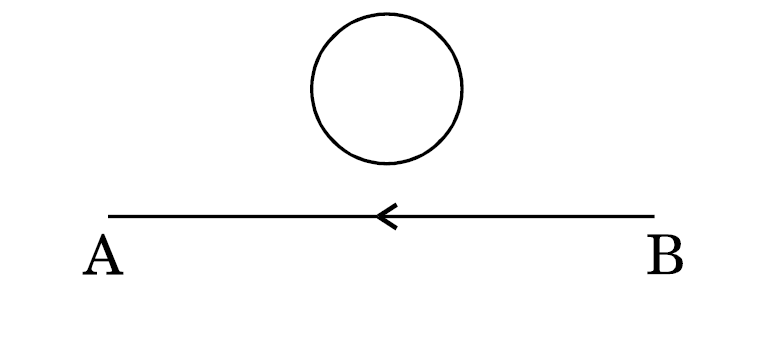
The electric current flowing in a wire in the direction from B to A is decreasing. Find out the direction of the induced current in the metallic loop kept above the wire as shown.

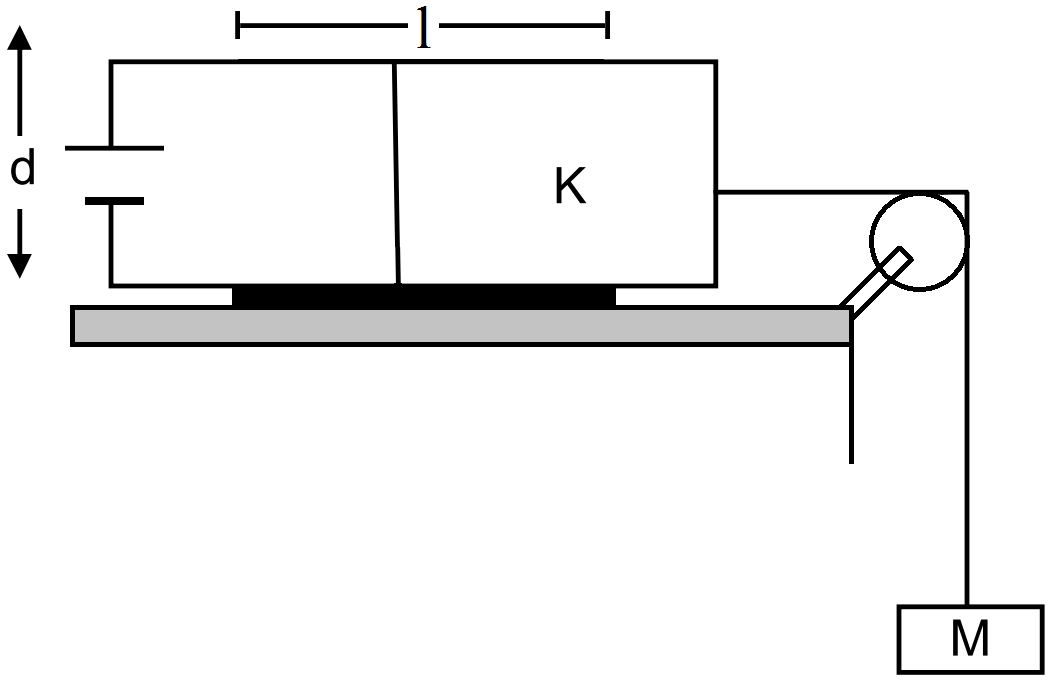
Consider the situation shown in figure. The width of each plate is b. The capacitor plates are rigidly clamped in the laboratory and connected to a battery of emf $\in.$ All surfaces are frictionless. Calculate the value of M for which the dielectric slab will stay in equilibrium.

When subatomic particles undergo reactions, energy is conserved, but mass is not necessarily conserved. However, a particle's mass “contributes” to its total energy, in accordance with Einstein's famous equation, E = mc2 In this equation, E denotes the energy carried by a particle because of its mass. The particle can also have additional energy due to its motion and its interactions with other particles. Consider a neutron at rest and well separated from other particles. It decays into a proton, an electron and an undetected third particle as given here: Neutron → proton + electron + ???

The given table summarizes some data from a single neutron decay. Electron volt is a unit of energy. Column 2 shows the rest mass of the particle times the speed of light squared.

Particle
Mass × c2 (MeV)
Kinetic energy (MeV)
Neutron
940.97
0.00
Proton
939.67
0.01
Electron
0.51
0.39
  1. From the given table, which properties of the undetected third particle can be calculate?
  1. Total energy, but not kinetic energy.
  2. Kinetic energy, but not total energy.
  3. Both total energy and kinetic energy.
  4. Neither total energy nor kinetic energy.
  1. Assuming the table contains no major errors, what can we conclude about the (mass × c2) of the undetected third particle?
  1. It is 0. 79 MeV
  2. It is 0.39 MeV
  3. It is less than or equal to 0.79 MeV; but we cannot be more precise.
  4. It is less than or equal to 0.40 MeV; but we cannot be more precise.
  1. Could this reaction occur?

Proton → neutron + other particles

  1. Yes, if the other particles have much more kinetic energy than mass energy.
  2. Yes, but only if the proton has potential energy (due to interactions with other particles). 
  3. No, because a neutron is more massive than a proton.
  4. No, because a proton is positively charged while a neutron is electrically neutral.
  1. How much mass has to be converted into energy to produce electric power of 500MW for one hour?
  1. 2 × 10-5kg
  2. 1 × 10⁻⁵kg
  3. 3 × 10⁻⁵kg
  4. 4 × 10⁻⁵kg
  1. The equivalent energy of 1g of substance is.
  1. 9 × 10¹³J
  2. 6 × 10¹²J
  3. 3 × 10¹³J
  4. 6 × 10¹³J
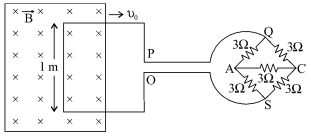
A square loop of a metallic wire of side 10 cm whose resistance is 1 ohm is moving with a constant velocity of as shown in the figure in a uniform magnetic field of $200 Wb / m ^2$. The magnetic field is normal to the plane of paper inwards. This loop is connected to a network of resistors of magnitude 3 ohms. Resistance of wire OS and PQ are negligible. What will be the magnitude of velocity, $v_0$ to flow one ampere of direct current in the loop? Also, what will be the direction of current?
Image
A police jeep is chasing a culprit going on a motorbike. The motorbike crosses a turning at a speed of 72km/h. The jeep follows it at a speed of 90km/h, crossing the turning ten seconds later than the bike. Assuming that they travel at constant speeds, how far from the turning will the jeep catch up with the bike?
A magnetic dipole of magnetic moment $0.72\sqrt{2}\text{ A-m}^2$ -is placed horizontally with the north pole pointing towards east. Find the position of the neutral point if the horizontal component of the earth's magnetic field is $18\mu\text{T.}$