MCQ
An engine is moving with uniform speed along a circular track emitting a sound of frequency $400\, Hz$ as shown in the figure. Speed of engine is $30\, m/sec$ and speed of sound is $330\, m/sec$. An observer is standing inside the track. Maximum frequency observed by the observer is
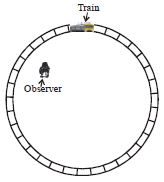
  • Less than $440\, Hz$
  • B
    Greater than $440\, Hz$
  • C
    Equal to $440\, Hz$
  • D
    Equal to $400\, Hz$

Answer

Correct option: A.
Less than $440\, Hz$
a

Need a full question paper?

Generate a complete, print-ready paper with questions like this in minutes — across 16+ boards, with answer keys.

Start Generating Free

Similar questions

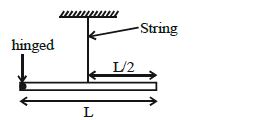
A uniform rod of mass $M$ and length $L$ is hinged about a point as shown in the fig. Initially the rod is kept horizontal by a massless string as shown. When string is cut the angular acceleration of the rod is 
Which of the following parameters are the same for all hydrogen-like atoms and ions in their ground states?
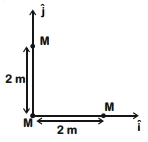
Three identical spheres, each of mass $M ,$ are placed at the corners of a right angle triangle with mutually perpendicular sides equal to $2 \;m$ (see figure). Taking the point of intersection of the two mutually perpendicular sides as the origin, find the position vector of centre of mass.
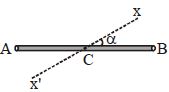
The moment of inertia of a uniform rod of length $2l$ and mass $m$ about an axis $xx'$ passing through its centre and inclined at an angle $\alpha $ is 
A particle is acted upon by a force of constant magnitude which is always perpendicular to the velocity of the particle. The motion of the particle takes place in a plane. It follows that  
Choose the correct relationship between Poisson ratio $(\sigma)$. bulk modulus $( K )$ and modulus of rigidity $(\eta)$ of a given solid object:
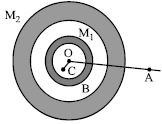
Two concentric shells of uniform density of mass $M_1$ and $M_2$ are situated as shown in the figure. The forces experienced by a particle of mass $m$ when placed at positions $A, B$ and $C$ respectively are (given $OA = p, \,OB = q$ and $OC = r$)
A solid horizontal surface is covered with a thin layer of oil. A rectangular block of mass $m =0.4 kg$ is at rest on this surface. An impulse of $1.0 N s$ is applied to the block at time $t =0$ so that it starts moving along the $x$-axis with a velocity $v ( t )= v _0^{ e ^{-1 / \tau}}$, where $v_0$ is a constant and $\tau=4 s$. The displacement of the block, in metres, at $t=\tau$ is. . . . . . . Take $e ^{-1}=0.37$
On giving equal amount of heat at constant volume to $1\, mol$ of a monoatomic and a diatomic gas the rise in temperature $(\Delta T)$ is more for
Total $K.E.$ of a sphere of mass $M$ rolling with velocity $V$ is: