MCQ
An engineer is given a fixed volume $V_m$ of metal with which to construct a spherical pressure vessel. Interestingly, assuming the vessel has thin walls and is always pressurized to near its bursting point, the amount of gas the vessel can contain, $n$ (measured in moles), does not depend on the radius $r$ of the vessel : instead it depends only on $V_m$ (measured in $m^3$) the temperature $T$ (mensured in $K$). the ideal gas constant $R$ (measured in $J/(K\ mol$ )), and the tensile strength of the metal $\sigma $ (measured in $N/m^2$ ) . Which of the following gives $n$ in terms of these parameters?
  • $n = \frac{2}{3}\,\frac{{{V_m}\sigma }}{{RT}}$
  • B
    $n = \frac{2}{3}\,\frac{{\sqrt[3]{{{V_m}\sigma }}}}{{RT}}$
  • C
    $n = \frac{2}{3}\,\frac{{\sqrt[3]{{{V_m}{\sigma ^2}}}}}{{RT}}$
  • D
    $n = \frac{2}{3}\,\frac{{\sqrt[3]{{{V_m}^2\sigma }}}}{{RT}}$
Answer

Correct option: A.
$n = \frac{2}{3}\,\frac{{{V_m}\sigma }}{{RT}}$
a
By dimensional analysis

Need a full question paper?

Generate a complete, print-ready paper with questions like this in minutes — across 16+ boards, with answer keys.

Start Generating Free

Similar questions

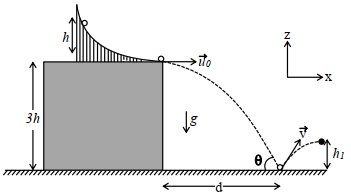
A slide with a frictionless curved surface, which becomes horizontal at its lower end,, is fixed on the terrace of a building of height $3 h$ from the ground, as shown in the figure. A spherical ball of mass $\mathrm{m}$ is released on the slide from rest at a height $h$ from the top of the terrace. The ball leaves the slide with a velocity $\vec{u}_0=u_0 \hat{x}$ and falls on the ground at a distance $d$ from the building making an angle $\theta$ with the horizontal. It bounces off with a velocity $\overrightarrow{\mathrm{v}}$ and reaches a maximum height $h_l$. The acceleration due to gravity is $g$ and the coefficient of restitution of the ground is $1 / \sqrt{3}$. Which of the following statement($s$) is(are) correct?

($AV$) $\vec{u}_0=\sqrt{2 g h} \hat{x}$ ($B$) $\vec{v}=\sqrt{2 g h}(\hat{x}-\hat{z})$  ($C$) $\theta=60^{\circ}$  ($D$) $d / h_1=2 \sqrt{3}$

If a rubber ball falls from a height $h$ and rebounds upto the height of $h / 2$. The percentage loss of total energy of the initial system as well as velocity ball before it strikes the ground, respectively, are :
Four rods of identical cross-sectional area and made from the same metal form the sides of square. The temperature of two diagonally opposite points and $T$ and $\sqrt 2 $ $T$ respective in the steady state. Assuming that only heat conduction takes place, what will be the temperature difference between other two points
A sample of gas with $\gamma=1.5$ is taken through an adiabatic process in which the volume is compressed from $1200\, {cm}^{3}$ to $300\, {cm}^{3}$. If the initial pressure is $200\, {kPa}$. The absolute value of the workdone by the gas in the process $= \,..... J.$
Water is flowing through a horizontal pipe of non-uniform cross-section. At the extreme narrow portion of the pipe, the water will have
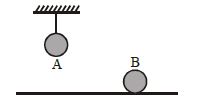
Two identical balls, $A$ and $B$ , of uniform composition and initially at the same temperature, each absorb exactly the same amount of heat. $A$ is hanging down from the ceiling while $B$ rests on the horizontal floor in the same room. Assuming no subsequent heat loss by the balls, which of the following statements is correct about their final temperatures, $T_A$ and $T_B$ , once the balls have reached their final state?
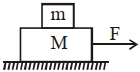
Two blocks $( m =0.5\, kg$ and $M =4.5\, kg$ ) are arranged on a horizontal frictionless table as shown in figure. The coefficient of static friction between the two blocks is $\frac{3}{7} .$ Then the maximum horizontal force that can be applied on the larger block so that the blocks move together is ......... $N.$ (Round off to the Nearest Integer) [Take g as $9.8\, ms ^{-2}$ ]
Consider two satellites $S_{1}$ and $S_{2}$ with periods of revolution $1\, hr$. and $8\, hr$. respectively revolving around a planet in circular orbits. The ratio of angular velocity of satellite $S_{1}$ to the angular velocity of satellites $S _{2}$ is
In an Isobaric process, the work done by a di$-$atomic gas is $10\, J ,$ the heat given to the gas will be (in $J$)