MCQ
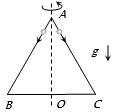
An equilateral triangle $ABC$ formed from a uniform wire has two small identical beads initially located at $A$.  The triangle is set rotating about the vertical axis $AO$.  Then the beads are released from rest simultaneously and allowed to slide down, one along $AB$ and the other along $AC$ as shown.  Neglecting frictional effects, the quantities that are conserved as the beads slide down, are
  • A
    Angular velocity and total energy (kinetic and potential)
  • Total angular momentum and total energy
  • C
    Angular velocity and moment of inertia about the axis of rotation
  • D
    Total angular momentum and moment of inertia about the axis of rotation

Answer

Correct option: B.
Total angular momentum and total energy
b
The $M I$ about the axis of rotation is not rotation is not constant as the perpendicular distance of the bead with the axis of rotation increases. Also since no external torque is acting, therefore,

$\tau_{e x t}=\frac{d L}{d t}$

$\Rightarrow L=\mathrm{constt.}$

$I \omega=\mathrm{constt.}$

since $l$ increases $\omega$ decreases.

Need a full question paper?

Generate a complete, print-ready paper with questions like this in minutes — across 16+ boards, with answer keys.

Start Generating Free

Similar questions

The number of air molecules per $\mathrm{cm}^3$ increased from $3 \times 10^{19}$ to $12 \times 10^{19}$. The ratio of collision frequency of air molecules before and after the increase in number respectively is $.........$
A tuning fork vibrating with a sonometer having a wire of length $20 \,cm$ produces $5$ beats per second. The beats frequency does not change if the length of the wire is changed to $21 \,cm$. The frequency of the tuning fork must be ............ $Hz$
The specific heat capacity of a body depends on:
  1. The heat give.
  2. The temperature raised.
  3. The mass of the body.
  4. The material of the body.
A body is dropped from a certain height $h$ ( $h$ is very large) and second body is thrown downward with velocity of $5 \,m / s$ simultaneouly. What will be difference in heights of the two bodies after $3 \,s$ is ....... $m$
A stick has its bottom end attached to a wall by a pivot and is held up by a massless string attached to its other end. Which of the following scenarios has the smallest tension in the string ? (Length of stick is same in all scenarios)
The number of molecules in a gas at pressure $1.64 \times {10^{ - 3}}$atmospheres and temperature $200\, K$ having the volume $1 \,cc$ are
A mixture of hydrogen and oxygen has volume $500\, {cm}^{3}$, temperature $300\, {K}$, pressure $400\, {kPa}$ and mass $0.76\, {g}$. The ratio of masses of oxygen to hydrogen will be :-
$Assertion$ : There is a stage when frictional force is not needed at all to provide the necessary centripetal force on a banked road.
$Reason$ : On a banked road, due to its inclination the vehicle tends to remain inwards without any chances of skidding.
When a sound wave of frequency $300 Hz$ passes through a medium the maximum displacement of a particle of the medium is $0.1 cm$. The maximum velocity of the particle is equal to
A sphere of diameter $7\,\, cm$ and mass $266.5 \,\,gm$ floats in a bath of a liquid. As the temperature is raised, the sphere just begins to sink at a temperature $35^o C$. If the density of a liquid at $0^o C$ is $1.527 \,\,gm/cc$, then neglecting the expansion of the sphere, the coefficient of cubical expansion of the liquid is$f$ :