MCQ
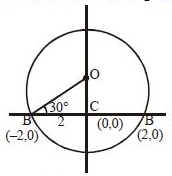
An equilateral triangle whose two vertices are $(-2,0)$ and $(2,0)$ and which lies in the first  and second quadrants only is circumscribed by a circle whose equation :-
  • A
    $ \sqrt 3 x^2 + \sqrt 3y^2 - 4x - 4 \sqrt 3 = 0$
  • B
    $\sqrt 3 x^2 + \sqrt 3 y^2 - 4x + 4 \sqrt 3 y = 0$
  • C
    $\sqrt 3 x^2 + \sqrt 3 y^2 - 4y + 4 \sqrt 3 = 0$
  • $\sqrt 3 x^2 + \sqrt 3 y^2 - 4y - 4 \sqrt 3 = 0$
Answer

Correct option: D.
$\sqrt 3 x^2 + \sqrt 3 y^2 - 4y - 4 \sqrt 3 = 0$
d
Let $A \equiv(-2,0)$ and $B \equiv(2,0) .$ The centre of the circle is the centroid of the equilateral trinagle.

$\therefore $ $0 \equiv\left(0, \frac{2}{\sqrt{3}}\right)$ and $\mathrm{OA}=\frac{4}{\sqrt{3}}$

$\therefore $ Required circle is

$(x-0)^{2}+\left(y-\frac{2}{\sqrt{3}}\right)^{2}=\frac{16}{3}$

i.e. $\sqrt{3} x^{2}+\sqrt{3} y^{2}-4 y-4 \sqrt{3}=0$

Need a full question paper?

Generate a complete, print-ready paper with questions like this in minutes — across 16+ boards, with answer keys.

Start Generating Free

Similar questions

Let $P$ is any point on the ellipse $\frac{{{x^2}}}{{{a^2}}} + \frac{{{y^2}}}{{{b^2}}} = 1$ . $S_1$ and $S_2$ its foci then maximum area of $\Delta PS_1S_2$ is (in square units)
The area bounded by the lines $y=\| x-1|-2 |$ is
Common roots of the equations $2{\sin ^2}x + {\sin ^2}2x = 2$ and $\sin 2x + \cos 2x = \tan x,$ are
Let $R$ be a rectangle, $C$ be a circle, and $T$ be a triangle in the plane. The maximum possible number of points common to the perimeters of $R, C$ and $T$ is
Let $A + 2B =$ $\left[ {\begin{array}{*{20}{c}}1&2&0\\6&{ - 3}&3\\{ - 5}&3&1 \end{array}} \right]$ and $2A - B =$ $\left[ {\begin{array}{*{20}{c}}2&{ - 1}&5\\ 2&{ - 1}&6\\0&1&2\end{array}} \right]$ then $Tr (A) - Tr (B)$ has the value equal to
Let $f:(0, \infty) \rightarrow \mathbb{R}$ be a differentiable function such that $f^{\prime}(x)=2-\frac{f(x)}{x}$ for all $x \in(0, x)$ and $f(1) \neq 1$. Then
Consider the function :$f\left( x \right) = \left[ x \right] + \left| {1 - x} \right|,\, - 1 \le x \le 3$ where $[x]$ is the greatest integer function
Statement $1 :f$ is not continuous at $x = 0, 1, 2$ and $3$
Statement $2 :f\left( x \right) = \left( \begin{array}{l}  - x,\,\,\,\,\,\,\,\,\, - 1 \le x < 0\\ 1 - x,\,\,\,\,\,\,\,0 \le x < 1\\ 1 + x,\,\,\,\,\,\,\,1 \le x < 2\,\\ 2 + x,\,\,\,\,\,\,2 \le x \le 3 \end{array} \right.$
A particle acted on by constant forces $4i + j - 3k$ and $3i + j - k$  is displaced from the point $i + 2j + 3k$ to the point $5i + 4j + k$. The total work done by the force is ............... $\mathrm{unit}$
If $A = \left[ {\begin{array}{*{20}{c}}
1&1\\
1&1
\end{array}} \right]$ and $\det ({A^n} - I) = 1 - {\lambda ^n}\,,\,n \in N$ then $\lambda $ is
The left hand derivative of $f(x) = \{x\} \, sin(\pi x)$ at $x = k$ ( $k$ is an integer), is $(\{ \}$ denotes the fraction part function $)$