MCQ
An example of rectilinear motion is:
  • A
    Apple falling from a tree.
  • B
    Motion of a car on road.
  • C
    A spinning top.
  • Both $(a)$ and $(b).$

Answer

Correct option: D.
Both $(a)$ and $(b).$
Apple falling from a tree and motion of a car on road are the examples of rectilinear motion

Need a full question paper?

Generate a complete, print-ready paper with questions like this in minutes — across 16+ boards, with answer keys.

Start Generating Free

Similar questions

Swati classified a few changes occurring around us as shown in the table.
S.No.
Changes
Type
$1.$
Sharpening of pencil.
Physical, reversible.
$2.$
Evaporation of water.
Physical, irreversible.
$3.$
Opening of a bud.
Chemical irreversible.
$4.$
Rusting of iron.
Chemical reversible.
Which of the changes is/ are classified correctly$?$
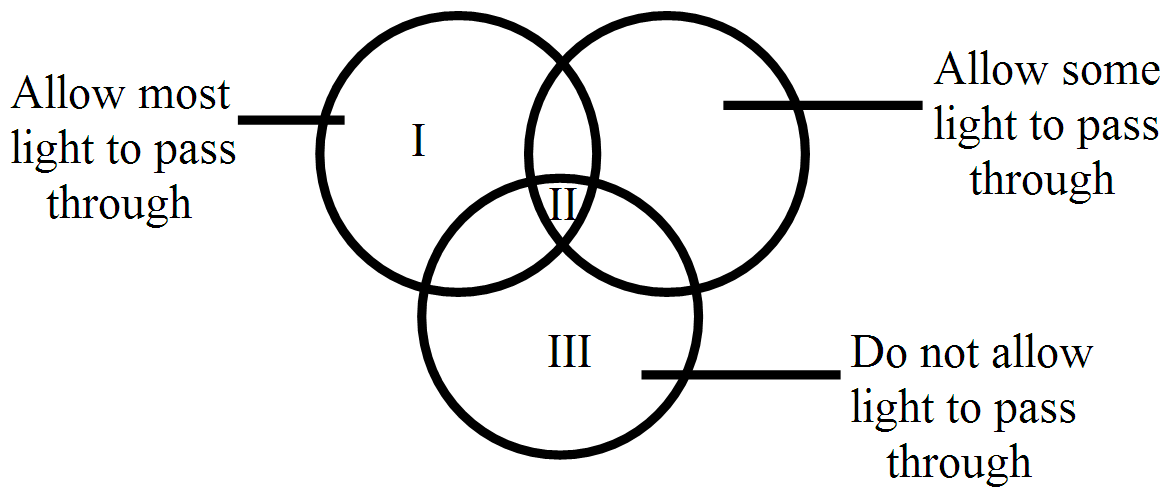
DIRECTIONS: Read the passage(s) given below and answer the questions that follow. Passage - Study the Venn diagram given below that represents the characteristics that materials may have. On the basis of the diagram answer the following questions.

Which of the following substance represent $(I)?$
Find the odd one out from the following.
Recently, in a science class test, you are asked a question where you have to say whether the statements are correct or not?
The questions in this segment consists of two statements, one labelled as 'Assertion $A$' and the other labelled as 'Reason $R$'. You are to examine these two statements carefully and decide if the Assertion A and Reason $R$ are individually true and if so, whether the reason is a correct explanation of the assertion. Select your answers to these items using codes given below.
Assertion $A$: Explosion of a bomb is an exothermic change.
Reason $R$: Large amount of heat energy is released during explosion of bomb.
The leaf has a network of veins on both sides of the midrib in:
The tap water is considered pure and fit for drinking. Pure water is tasteless but tap water has some taste. This taste in tap water is due to:
DIRECTIONS: Read the passage $(s)$ given below and answer the questions that follow. Passage - We know that materials differ in some of their properties and they may also be similar in some of their properties. Materials can be grouped on the basis of similarities or differences in their properties. Why we group materials in everyday life?
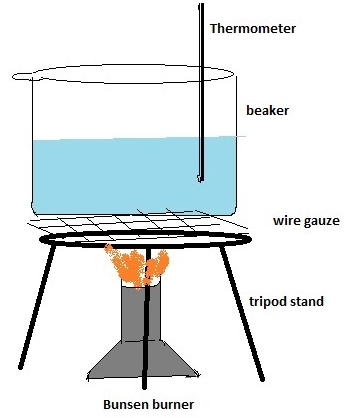
Raveena covered a beaker of boiled water with a metal tray as shown in the diagram.

The beaker and metal tray were then removed from the tripod stand and left on the table. After two minutes, which of the following can be observed?
Which of the following are involved in filtration technique?