An ice block floats in a liquid whose density is less than water. A part of block is outside the liquid. When whole of ice has melted, the liquid level will
Medium
Download our app for free and get started
(b)
Ice is lighter than water. When ice melts, the volume occupied by water is less than that of ice. Due to which the level of water goes down.

Download our appand get started for free
Experience the future of education. Simply download our apps or reach out to us for more information. Let's shape the future of learning together!No signup needed.*
Similar Questions
- 1A tank of height $5\, m$ is full of water. There is a hole of cross sectional area $1\, cm^2$ in its bottom. The initial volume of water that will come out from this hole per second isView Solution
- 2A liquid mixture of volume $V$, has two liquids as its ingredients with densities $\alpha$ and $\beta$. If density of the mixture is $\sigma$, then mass of the first liquid in mixture is ............View Solution
- 3The cross sectional area of a horizontal tube increases along its length linearly, as we move in the direction of flow. The variation of pressure, as we move along its length in the direction of flow ($x-$ direction), is best depicted by which of the following graphsView Solution
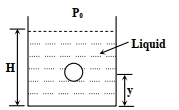
- 4A small spherical monoatomic ideal gas bubble $\left(\gamma=\frac{5}{3}\right)$ is trapped inside a liquid of density $\rho_{\ell}$ (see figure). Assume that the bubble does not exchange any heat with the liquid. The bubble contains n moles of gas. The temperature of the gas when the bubble is at the bottom is $\mathrm{T}_0$, the height of the liquid is $\mathrm{H}$ and the atmospheric pressure is $\mathrm{P}_0$ (Neglect surface tension).View Solution
Figure: $Image$
$1.$ As the bubble moves upwards, besides the buoyancy force the following forces are acting on it
$(A)$ Only the force of gravity
$(B)$ The force due to gravity and the force due to the pressure of the liquid
$(C)$ The force due to gravity, the force due to the pressure of the liquid and the force due to viscosity of the liquid
$(D)$ The force due to gravity and the force due to viscosity of the liquid
$2.$ When the gas bubble is at a height $\mathrm{y}$ from the bottom, its temperature is
$(A)$ $\mathrm{T}_0\left(\frac{\mathrm{P}_0+\rho_0 \mathrm{gH}}{\mathrm{P}_0+\rho_t \mathrm{gy}}\right)^{2 / 5}$
$(B)$ $T_0\left(\frac{P_0+\rho_t g(H-y)}{P_0+\rho_t g H}\right)^{2 / 5}$
$(C)$ $\mathrm{T}_0\left(\frac{\mathrm{P}_0+\rho_t \mathrm{gH}}{\mathrm{P}_0+\rho_t \mathrm{gy}}\right)^{3 / 5}$
$(D)$ $T_0\left(\frac{P_0+\rho_t g(H-y)}{P_0+\rho_t g H}\right)^{3 / 5}$
$3.$ The buoyancy force acting on the gas bubble is (Assume $R$ is the universal gas constant)
$(A)$ $\rho_t \mathrm{nRgT}_0 \frac{\left(\mathrm{P}_0+\rho_t \mathrm{gH}\right)^{2 / 5}}{\left(\mathrm{P}_0+\rho_t \mathrm{gy}\right)^{7 / 5}}$
$(B)$ $\frac{\rho_{\ell} \mathrm{nRgT}_0}{\left(\mathrm{P}_0+\rho_{\ell} \mathrm{gH}\right)^{2 / 5}\left[\mathrm{P}_0+\rho_{\ell} \mathrm{g}(\mathrm{H}-\mathrm{y})\right]^{3 / 5}}$
$(C)$ $\rho_t \mathrm{nRgT} \frac{\left(\mathrm{P}_0+\rho_t g \mathrm{H}\right)^{3 / 5}}{\left(\mathrm{P}_0+\rho_t g \mathrm{~g}\right)^{8 / 5}}$
$(D)$ $\frac{\rho_{\ell} \mathrm{nRgT}_0}{\left(\mathrm{P}_0+\rho_{\ell} \mathrm{gH}\right)^{3 / 5}\left[\mathrm{P}_0+\rho_t \mathrm{~g}(\mathrm{H}-\mathrm{y})\right]^{2 / 5}}$
Give the answer question $1,2,$ and $3.$
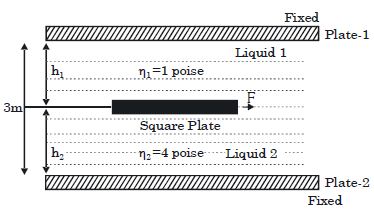
- 5A thin square plate of side $2\ m$ is moving at the interface of two very viscous liquids of viscosities ${\eta _1} = 1$ poise and ${\eta _2} = 4$ poise respectively as shown in the figure. Assume a linear velocity distribution in each fluid. The liquids are contained between two fixed plates. $h_1 + h_2 = 3\ m$ . A force $F$ is required to move the square plate with uniform velocity $10\ m/s$ horizontally then the value of minimum applied force will be ........ $N$View Solution
- 6Water from a pipe is coming at a rate of $100\, litres$ per minute. If the radius of the pipe is $5\, cm$, the Reynolds number for the flow is of the order of : (density of water $= 1000\, kg/m^3$, coefficient of viscosity of water $= 1\, mPa\, s$)View Solution
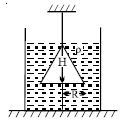
- 7A cone of radius $R$ and height $H$, is hanging inside a liquid of density $\rho$ by means of a string as shown in the figure. The force, due to the liquid acting on the slant surface of the cone isView Solution
- 8The top of a water tank is open to air and its water level is maintained. It is giving out $0.74\,m^3$ water per minute through a circular opening of $2\,cm$ radius in its wall. The depth of the centre of the opening from the level of water in the tank is close to........ $m$View Solution
- 9The two thigh bones (femures), each of cross-sectional area $10 \,cm ^2$ support the upper part of a person of mass $50 \,kg$. The average pressure sustained by the femures is ............. $N / m ^2$View Solution
- 10An object with uniform density $\rho$ is attached to a spring that is known to stretch linearly with applied force as shown below.When the spring object system is immersed in a liquid of density $\rho_1$ as shown in the above figure, the spring stretches by an amount $x_1\left(\rho > \rho_1\right)$. When the experiment is repeated in a liquid of density $\left(\rho_2 < \rho_1\right)$, the spring stretches by an amount $x_2$. Neglecting any buoyant force on the spring, the density of the object isView Solution