MCQ
An ice cube has a bubble inside. When viewed from one side the apparent distance of the bubble is $12\,cm$. when viewed from the opposite side, the apparent distance of the bubble is observed as $4\,cm$. If the side of the ice cube is $24\,cm$, the refractive index of the ice cube is $.....$.
  • A
    $\frac{4}{3}$
  • $\frac{3}{2}$
  • C
    $\frac{2}{3}$
  • D
    $\frac{6}{5}$

Answer

Correct option: B.
$\frac{3}{2}$
b
$d _{\text {appprent }}=\frac{ d _{\text {actual }}}{\mu_{\text {rel }}}$

$12=\frac{ x }{\mu}$

$4=\frac{24- x }{\mu}$

On solving we get $\mu=1.5$

Need a full question paper?

Generate a complete, print-ready paper with questions like this in minutes — across 16+ boards, with answer keys.

Start Generating Free

Similar questions

This question has Statement $1$ and Statement $2$ . Of the four choices given after the Statements, choose the one that best describes the two Statements.

Statement $1$: A charged particle is moving at right angle to a static magnetic field . During the motion the kinetic energy of the charge remains unchanged.

Statement $2$: Static magnetic field exert force on a moving charge in the direction perpendicular to the magnetic field.

A point source of light is placed at a distance, of 2f from a converging lens of focal length f. The intensity on the other side of the lens is maximum at a distance:
Finger prints on a piece of paper may be detected by sprinkling fluorescent powder on the paper and then looking it into
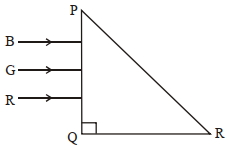
Three rays of light, namely red (R), green (G) and blue (B) are incident on the face $PQ$ of a right angled prism PQR as shown in figure.

The refractive indices of the material of the prism for red, green and blue wavelength are $1.27, 1.42$ and $1.49$ respectively. The colour of the ray(s) emerging out of the face $PR$ is:

A freely suspended magnet aligns in which direction?
Two particles $X$ and $Y$ having equal charge, after being accelerated through the same potential difference enter a region of uniform magnetic field and describe circular paths of radii $R_1$ and $R_2$ respectively. The ratio of the mass of $X$ to that of $Y$ is:
Copper and silicon is cooled from $300\; K$ to $60\; K$, the specific resistance
Equal mass of three liquids are kept in three identical cylindrical vessels $A, B$ and $C$. The densities are $P_A, P_B, P_C$ with $\mathrm{P}_{\mathrm{A}}<\mathrm{P}_{\mathrm{B}}<\mathrm{P}_{\mathrm{C}}$ The force on the base will be:
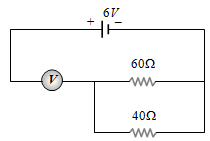
The measurement of voltmeter in the following circuit is
If Young's double slit experiment is performed in water: