MCQ
An ice cube is suspended in vacuum in a gravity free hall. As the ice melts it.
  • A
    Will retain its cubical shape.
  • Will change its shape to spherical.
  • C
    Will fall down on the floor of the hall.
  • D
    Will fly up.

Answer

Correct option: B.
Will change its shape to spherical.
As the ice cube melts completely, the water thus formed will have minimum surface area due to its surface tension. Any state of matter that has a minimum surface area to its volume takes the shape of a sphere. Therefore, as the ice melts, it will take the shape of a sphere.

Need a full question paper?

Generate a complete, print-ready paper with questions like this in minutes — across 16+ boards, with answer keys.
Start Generating Free

Similar questions

A man of $60\,kg$ is running on the road and suddenly jumps into a stationary trolly car of mass $120\,kg$. Then. the trolly car starts moving with velocity $2\,ms ^{-1}$. The velocity of the running man was _________$ms ^{-1}$. when he jumps into the car
Dimensional formula of resistivity is
Let $V$ and $E$ be the gravitational potential and gravitational field at a distance $r$ from the centre of a uniform spherical shell. Consider the following two statements:
$A.$ The plot of $V$ against $r$ is discontinuous.
$B.$ The plot of $E$ against $r$ is discontinuous.
Two stones are thrown with same speed $u$ at different angles from ground in air. If both stones have same range and height attained by them are $h_1$ and $h_2$, then $h_1+h_2$ is equal to .......
A man is standing at a spring platform. Reading of spring balance is $60\, kg$ wt. If man jumps outside platform, then reading of spring balance
Two tubes of radii $r_1$ and $r_2$, and lengths $l_1$ and $l_2$, respectively, are connected in series and a liquid flows through each of them in streamline conditions. $P_1$ and $P_2$ are pressure differences across the two tubes. If $P_2$ is $4P_1$ and $l_2$ is $ \frac{l_1}{4}$ , then the radius $r_2$ will be equal to
The temperature of the sun is measured with
$|\lambda\text{A}|=\lambda|\text{A}|,\ \text{if}$
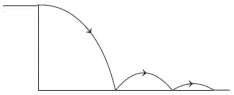
A ball is thrown horizontally from a height with a certain initial velocity at time $t=0$. The ball bounces repeatedly from the ground with the coefficient of restitution less than $1$ as shown below. Neglecting air resistance and taking the upward direction as positive, which figure qualitatively depicts the vertical component of the ball's velocity $v_y$ as a function of time $t$ ?
Given vector $\overrightarrow A = 2\hat i + 3\hat j, $ the angle between $\overrightarrow A $and $y-$axis is