Question
An ideal diode should pass a current freely in one direction and should stop it completely in the opposite direction. Which is closer to ideal-vacuum diode or a p-n junction diode?

Answer

It should be an ideal vacuum diode. When a p-n junction diode is reverse biassed then a small current called reverse current flows across the diode. As the the p‒n junction diode allows some current in reverse biassed condition also so the given diode cannot be a p-n junction diode.

Need a full question paper?

Generate a complete, print-ready paper with questions like this in minutes — across 16+ boards, with answer keys.
Start Generating Free

Similar questions

  1. Describe the working of photodiode by drawing the circuit diagram.
  2. Draw the characteristics of a photodiode for different illumination intensities.
  3. Why is photodiode operated in reverse bias even though the reverse bias current is much weaker than the current in forward bias?
The current through a wire depends on time as $\text{i}=\text{i}_0+\alpha\text{t},$
Where $\text{i}_0=10\text{A}$ and $\alpha=4\text{A/ s}.$ Find the charge that crosses through a section of the wire in 10 seconds.
The temperature and the relative humidity are 300K and 20% in a room of volume 50m3. The floor is washed with water, 500g of water sticking on the floor. Assuming no communication with the surrounding, find the relative humidity when the floor dries. The changes in temperature and pressure may be neglected. Saturation vapour pressure at 300K = 3.3kPa.
A ball is projected vertically upward with a speed of 50m/s. Find:
  1. The maximum height.
  2. The time to reach the maximum height.
  3. The speed at half the maximum height. Take g = 10m/s2.
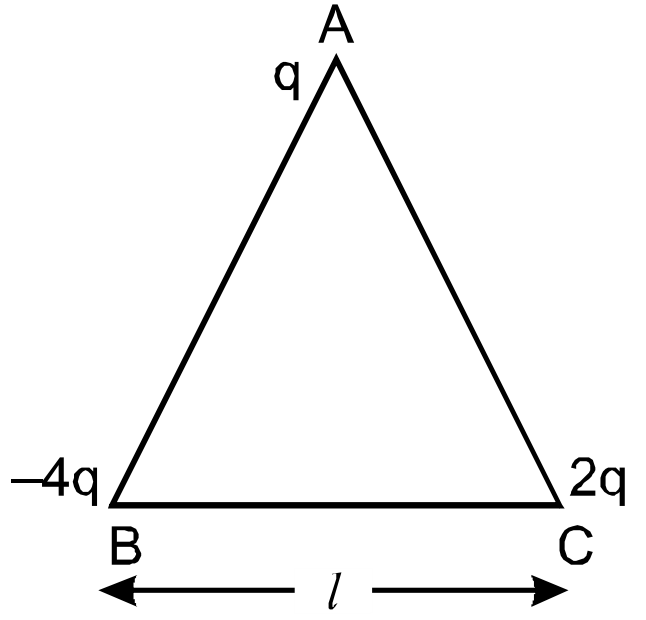
  1. Three point charges q, -4q and 2q are placed at the vertices of an equilateral triangle ABC of side ‘l’ as shown in the figure. Obtain the expression for the magnitude of the resultant electric force acting on the charge q.

  1. Find out the amount of the work done to separate the charges at infinite distance.
A beam of light having wavelengths distributed uniformly between 450nm to 550nm passes through a sample of hydrogen gas. Which wavelength will have the least intensity in the transmitted beam?
Can an electromagnetic wave be deflected by an electric field or a magnetic field?
  1. How does one explain the emission of electrons from a photosensitive surface with the help of Einstein's photoelectric equation?
  2. The work function of the following metals is given: Na 2.75ev, K = 2.3 eV, Mo = 4.17eV and Ni = 5.15eV. Which of these metals will not cause photoelectric emission for radiation of wavelength 3300 Å from a laser source placed 1m away from these metals? What happens if the laser source is brought nearer and placed 50cm away?
If one of the two electrons of a H2 molecule is removed, we get a hydrogen molecular ion $\text{H}^+_2​.$ In the ground state of an $\text{H}^+_2​,$ the two protons are separated by roughly 1.5 Å, and the electron is roughly 1 Å from each proton. Determine the potential energy of the system. Specify your choice of the zero of potential energy.
A coil of inductance 5.0mH and negligible resistance is connected to the oscillator of the previous problem. Find the peak currents in the circuit for $\omega=100\text{s}^{-1},500\text{s}^{-1},1000\text{s}^{-1}.$