MCQ
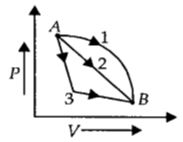
An ideal gas goes from state $A$ to state $B$ via three different processes as indicated in the $P-V$ diagram. If $Q_1, Q_2, Q_3$ indicate the heat absorbed by the gas along the three processes and $\Delta U_1, \Delta U_2, \Delta U_3$ 
indicate the change in internal energy along the three processes respectively, then 
  • A
    ${Q_1} < {Q_2} < {Q_3}$ and $\Delta U_1=\Delta U_2=\Delta U_3$
  • B
    ${Q_1} < {Q_2} = {Q_3}$ and $\Delta U_1 > \Delta U_2 > \Delta U_3$
  • C
    ${Q_1} = {Q_2} > {Q_3}$ and $\Delta U_1 > \Delta U_2 > \Delta U_3$
  • ${Q_1} > {Q_2} > {Q_3}$ and $\Delta U_1 = \Delta U_2 = \Delta U_3$
Answer

Correct option: D.
${Q_1} > {Q_2} > {Q_3}$ and $\Delta U_1 = \Delta U_2 = \Delta U_3$
d
Change in internal energy is path independent and depends only on the initial and final states.

As the initial and final states in the three processes are same. Therefore,

$\Delta {u_1} = \Delta {u_2} = \Delta {u_3}$

Workdone, $W=Area\,under\,P-V\,graph$

As area under curve $1>$ area under curve $2>$ area under curve $3$

$\therefore {W_1} > {W_2} > {W_3}$

According to first law of thermodynamics,

$Q = W + \Delta u$

$As{W_1} > {W_2} > {W_3}\,and\,\Delta {u_1} = \Delta {u_2} = \Delta {u_3}$

$\therefore {Q_1} > {Q_2} > {Q_3}$

Need a full question paper?

Generate a complete, print-ready paper with questions like this in minutes — across 16+ boards, with answer keys.

Start Generating Free

Similar questions

The value of restitution coefficient e for perfectly elastic collision is:
Let $\theta$ denote the angular displacement of a simple pendulum oscillating in a vertical plane. If the mass of the bob is m, then tension in the string is mg $\cos\theta$
A lift performs the first part of its ascent with uniform acceleration $a$ and the remaining with uniform retardation $2a$. If $t$ is the time of ascent, find the depth of the shaft.
An object of mass $m$ moves with constant speed in a circular path of radius $R$ under the action of a force of constant magnitude $F$. The kinetic energy of object is ............
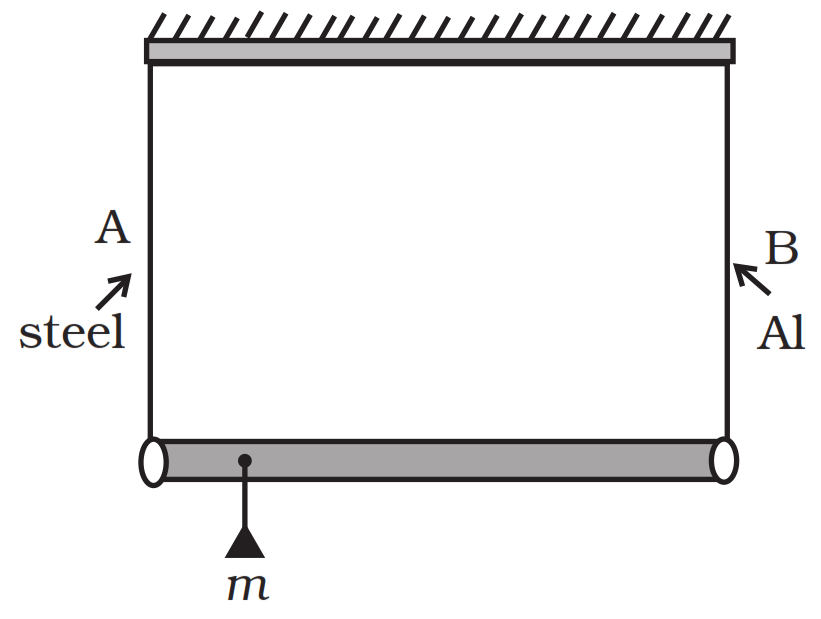
A rod of length l and negligible mass is suspended at its two ends by two wires of steel (wire A) and aluminium (wire B) of equal lengths. The cross - sectional areas of wires A and B are 1.0mm2 and 2.0mm2, respectively.
(Yal = 70 × 10Nm-2 and Ysteel = 200 × 109Nm-2)

A man carrying a monkey on his shoulder does cycling smoothly on a circular track of radius $9 \mathrm{~m}$ and completes $120$ revolutions in $3$ minutes. The magnitude of centripetal acceleration of monkey is (in $\mathrm{m} / \mathrm{s}^2$ ):
Ultrasonic signal sent from $SONAR$ returns to it after reflection from a rock after a lapse of $1 \,sec.$ If the velocity of ultrasound in water is $1600 ms^{-1}$, the depth of the rock in water is ..... $m$
A ball is dropped from a height $h$ above ground. Neglect the air resistance, its velocity $(v)$ varies with its height above the ground as
A block of wood is floating on water at $0^{\circ} C$ with volume $V_0$ above water. When the temperature of water increases from $0$ to $10^{\circ} C$, the change in the volume of the block that is above water is best described schematically by the graph.
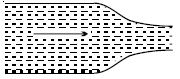
Water flows through a frictionless duct with a cross-section varying as shown in figure. Pressure $p$ at points along the axis is represented by