MCQ
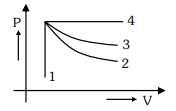
An ideal gas undergoes four different processes from the same initial state as shown in the figure below. Those processes are adiabatic, isothermal, isobaric and isochoric. The curve which represents the adiabatic process among $1,2,3$ and $4$ is
  • $2$
  • B
    $3$
  • C
    $4$
  • D
    $1$

Answer

Correct option: A.
$2$
a
$1$ : Isochoric

$2$: Adiabatic

$3$ : Isothermal

$4$: Isobaric

Need a full question paper?

Generate a complete, print-ready paper with questions like this in minutes — across 16+ boards, with answer keys.

Start Generating Free

Similar questions

Ice at $-20\,^oC$ is added to $50\,g$ of water at $40\,^oC.$ When the temperature of the mixture reaches $0\,^oC,$ it is found that $20\,g$ of ice is still unmelted. The amount of ice added to the water was close to ........$g$ (Specific heat of water $= 4.2\,J/g/^oC)$ Heat of fusion of water at $0^oC = 334\,J/g$ )
If $I_1$ is the moment of inertia of a thin rod about an axis perpendicular to its length and passing through its centre of mass, and $I_2$ is the moment of inertia of the ring formed by bending the rod, then
Which of the following is a necessary and sufficient condition for S.H.M.
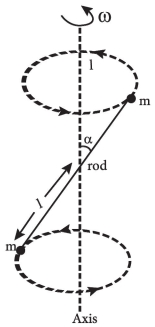
A massless rod $S$ having length $2I$ has equal point masses attached to its two ends as shown in figure. The rod is rotating about an axis passing through its centre and making angle $\alpha$ with the axis. The magnitude of change of momentum of rod i.e. $\left|\frac{ dL }{ dt }\right|$ equals
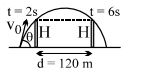
A projectile crosses two walls of equal height $H$ symmetrically as shown The angle of projection of the projectile is
Average pressure pav is defined as
If particle is executing simple harmonic motion with time period $T$, then the time period of its total mechanical energy is ...........
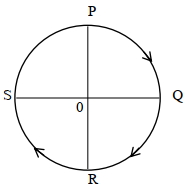
A cyclist starts from the point $P$ of a circular ground of radius $2 \mathrm{~km}$ and travels along its circumference to the point $\mathrm{S}$. The displacement of a cyclist is:
A policeman on duty detects a drop of $10\%$ in the pitch of the horn of a moving car as it crosses him. If the velocity of sound is $330 \,m/s,$ the speed of the car will be ..... $m/s$
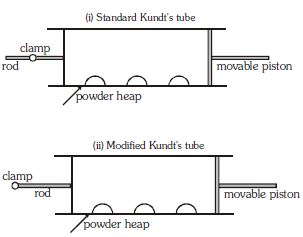
In the Kundts tube experiment (shown in fig. $(i)$), the rod is clamped at the end instead of clamping it at the center as shown in fig. $(ii).$ It is known that speed of sound in air is $330\  m/s$, powder piles up at successive distance of $0.6\  m$ and length of rod used is $1\ m$, speed of sound in rod is .... $\frac{m}{s}$