MCQ
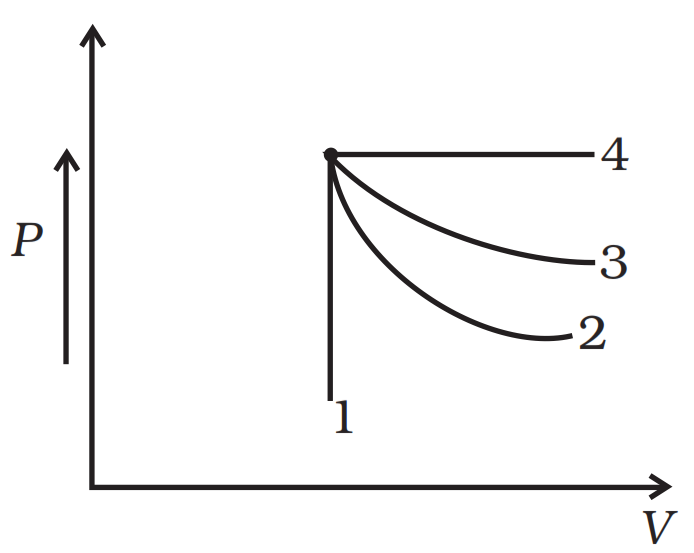
An ideal gas undergoes four different processes from thesame initial state (Fig.). Four processes are adiabatic, isothermal, isobaric and isochoric. Out of 1, 2, 3 and 4 whichone is adiabatic.
  • A
    4
  • B
    3
  • 2
  • D
    1

Answer

Correct option: C.
2
4 is isobaric process, 1 is isochoric. out of 3 and 2, 3 has the smaller slope (magnitude) hence is isothermal. Remaining process 2 is adiabatic.

Need a full question paper?

Generate a complete, print-ready paper with questions like this in minutes — across 16+ boards, with answer keys.

Start Generating Free

Similar questions

A body is at rest at $x=0$. At $t=0$, it starts moving in the positive $x-$ direction with a constant acceleration. At the same instant another body passes through $x=0$ moving in the positive $x$ direction with a constant speed. The position of the first body is given by $x_{1} (t)$ after time $t$ and that of the second body by $x_{2}(t)$ after the same time interval. Which of the following graphs correctly describe $\left(x_{1}-x_{2}\right)$ as a function of time $t$?
Increase in length of a wire is $1\, mm$ when suspended by a weight. If the same weight is suspended on a wire of double its length and double its radius, the increase in length will be  ........ $mm$
If the tension in the cable supporting an elevator is equal to the weight of the elevator, the elevator may:
A clock has $75 \mathrm{~cm}, 60 \mathrm{~cm}$ long second hand and minute hand respectively. In $30$ minutes duration the tip of second hand will travel $x$ distance more than the tip of minute hand. The value of $x$ in meter is nearly (Take $\pi=3.14$ ) :
The vectors $\overrightarrow A $ and $\overrightarrow B$  lie in a plane. Another vector $\overrightarrow C $ lies outside this plane. The  resultant $\overrightarrow A + \overrightarrow B + \overrightarrow C$ of these three vectors
Which of the following statements are true for a stationary wave?
The torque of a force $5 \hat{i}+3 \hat{j}-7 \hat{k}$ about the origin is $\tau$. If the force acts on a particle whose position vector is $2 \hat{i}+2 \hat{j}+\hat{k}$, then the value of $\tau$ will be.
What happens to the average velocity when a body falls under gravity with terminal velocity?
The work done in an adiabatic change in a gas depends only on
Which of the four arrangements in the figure correctly shows the vector addition of two forces $\overrightarrow {{F_1}} $ and $\overrightarrow {{F_2}} $ to yield the third force $\overrightarrow {{F_3}} $