An Indian rubber cord $L$ metre long and area of cross-section $A$ $metr{e^2}$ is suspended vertically. Density of rubber is $D$ $kg/metr{e^3}$ and Young's modulus of rubber is $E$ $newton/metr{e^2}$. If the wire extends by $l$ metre under its own weight, then extension $l$ is
Diffcult


Download our appand get started for free
Experience the future of education. Simply download our apps or reach out to us for more information. Let's shape the future of learning together!No signup needed.*
Similar Questions
- 1For a constant hydraulic stress on an object, the fractional change in the object's volume $\left( {\frac{{\Delta V}}{V}} \right)$ and its bulk modulus $(B)$ are related asView Solution
- 2A metal rod of cross-sectional area $10^{-4} \,m ^{2}$ is hanging in a chamber kept at $20^{\circ} C$ with a weight attached to its free end. The coefficient of thermal expansion of the rod is $2.5 \times 10^{-6} \,K ^{-1}$ and its Young's modulus is $4 \times 10^{12} \,N / m ^{2}$. When the temperature of the chamber is lowered to $T$, then a weight of $5000 \,N$ needs to be attached to the rod, so that its length is unchanged. Then, $T$ is ............ $^{\circ} C$View Solution
- 3View SolutionWhich of the following is the graph showing stress-strain variation for elastomers?
- 4View SolutionIf the length of a wire is reduced to half, then it can hold the ......... load
- 5The ratio of the lengths of two wires $A$ and $B$ of same material is $1 : 2$ and the ratio of their diameter is $2 : 1.$ They are stretched by the same force, then the ratio of increase in length will beView Solution
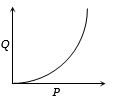
- 6The graph shows the behaviour of a length of wire in the region for which the substance obeys Hook’s law. $P$ and $Q$ representView Solution
- 7On increasing the length by $0.5\, mm$ in a steel wire of length $2\, m$ and area of cross-section $2\,m{m^2}$, the force required is $[Y$ for steel$ = 2.2 \times {10^{11}}\,N/{m^2}]$View Solution
- 8View SolutionYoung's modulus of elasticity of material depends upon
- 9View SolutionFour uniform wires of the same material are stretched by the same force. The dimensions of wire are as given below. The one which has the minimum elongation has
- 10View SolutionHook's law defines