MCQ
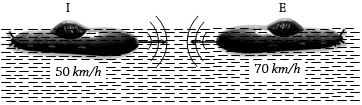
An Indian submarine and an enemy submarine move towards each other during maneuvers in motionless water in the Indian ocean. The Indian submarine moves at $50 km/h$, and the enemy submarine at $70 km/h$. The Indian sub sends out a sonar signal (sound wave in water) at $1000 Hz$. Sonar waves travel at $5500 km/h$. What is the frequency detected by the Indian submarine .... $kHz$
  • $1.02$
  • B
    $2$
  • C
    $2.5$
  • D
    $4.7$

Answer

Correct option: A.
$1.02$
a
(a) Frequency detected by Indian submarine

$n' = n\,\left[ {\frac{{v + {v_{sub}}}}{{v - {v_{sub}}}}} \right] = 1000\,\left[ {\frac{{5500 + 50}}{{5500 - 50}}} \right] \approx 1.02\,kHz.$

Need a full question paper?

Generate a complete, print-ready paper with questions like this in minutes — across 16+ boards, with answer keys.

Start Generating Free

Similar questions

A metallic block of density $5\,gm \,cm^{-3}$ and having dimensions $5 cm × 5 cm × 5 cm$ is weighed in water. Its apparent weight will be
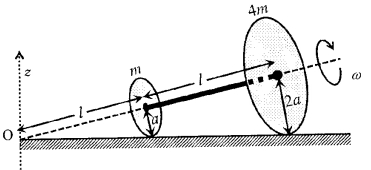
Two thin circular discs of mass $m$ and $4 m$, having radii of $a$ and $2 a$, respectively, are rigidly fixed by a massless, rigid rod of length $l=\sqrt{24} a$ through their centers. This assembly is laid on a firm and flat surface, and set rolling without slipping on the surface so that the angular speed about the axis of the rod is $\omega$. The angular momentum of the entire assembly about the point ' $O$ ' is $\vec{L}$ (see the figure). Which of the following statement($s$) is(are) true?

($A$) The center of mass of the assembly rotates about the $z$-axis with an angular speed of $\omega / 5$

($B$) The magnitude of angular momentum of center of mass of the assembly about the point $O$ is $81 m a^2 \omega$

($C$) The magnitude of angular momentum of the assembly about its center of mass is $17 \mathrm{ma}^2 \mathrm{\omega} / 2$

($D$) The magnitude of the $z$-component of $\vec{L}$ is $55 \mathrm{ma}^2 \omega$

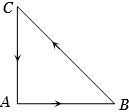
Three forces starts acting simultaneously on a particle moving with velocity $\vec v.$ These forces are represented in magnitude and direction by the three sides of a triangle $ABC$ (as shown). The particle will now move with velocity
A body is thrown at angle $30^{\circ}$ to the horizontal with the velocity of $30\; m / s$. After $1\;sec$, its velocity will be (in $m/s$) $\left(g=10\; m / s ^{2}\right)$
The motion in which all points of a moving body move uniformly in the same line or direction is known as:
At ...... $ ^o C$ temperature, the mean kinetic energy of ${O_2}$ will be the same for ${H_2}$ molecules at $- 73^o C$
Two capillary of length $L $ and $2L$  and of radius $R$  and $2R$  are connected in series. The net rate of flow of fluid through them will be (given rate of the flow through single capillary, $X = \pi P{R^4}/8\eta L)$
A rod of weight $W$ is supported by two parallel knife edges $A$ and $B$ and is in equilibrium in a horizontal position. The knives are at a distance $d$ from each other. The centre of mass of the rod is at distance $x$ from $A.$ The normal reaction on $A$ is
A particle of mass $m$ moving towards west with speed $v$ collides with another particle of mass $m$ moving towards south. If two particles stich to each other, the speed of the new particle of mass $2 m$ will be ..........
Two sound waves of intensity $2 \,W / m ^2$ and $3 \,W / m ^2$ meet at a point to produce a resultant intensity $5 \,W / m ^2$. The phase difference between two waves is ......