Question
An individual and a population has certain characteristics. Name these attributes with definitions.
Answer

A population has certain attributes that an individual organism does not. An individual may have births and deaths, but a population has birth rates and death rates. In a population these rates refer to per capita births and deaths, respectively. The rates, hence, expressed as change in numbers (increase or decrease) with respect to members of the population.
  • Another attribute characteristic of a population is sex ratio. An individual is either a male or a female but a population has a sex ratio (e.g., 60 percent of the population are females and 40 per cent males).
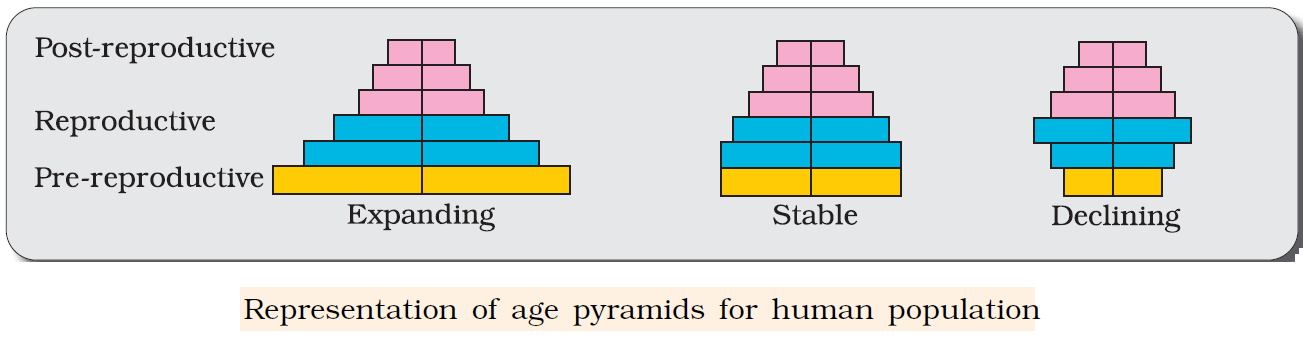
  • A population at any given time is composed of individuals of different ages. If the age distribution (per cent individuals of a given age or age group) is plotted for the population, the resulting structure is called an age pyramid. For human population, the age pyramids generally show age distribution of males and females in a combined diagram. The shape of the pyramids reflects the growth status of the population (a) whether it is growing, (b) stable or (c) declining.

Need a full question paper?

Generate a complete, print-ready paper with questions like this in minutes — across 16+ boards, with answer keys.

Start Generating Free

Similar questions

Trace the events taking place in a flower from the time of pollen grain entry up to the completion of fertilisation.
Microbes can be used to decrease the use of chemical fertilisers and pesticides. Explain how this can be accomplished.
Match the items in Column I with those in Column II.
S.No Column I S.No Column II
A. ABO blood group in humans 1. Polygenic inheritance
B. Flower colour in snapdragon 2. Mendelian genetic disorder
C. Human skin colour 3. Sex-linked Mendelian disorder
D. Phenylketonuria 4. Incomplete dominance
    5. Multiple allelism
Categorise the following plants into hydrophytes, halophytes, mesophytes and xerophytes. Give reasons for your answers.
  1. Salvinia.
  2. Opuntia.
  3. Rhizophora.
  4. Mangifera.
Draw a neat labelled sketch of Graafian follicle.
  1. Draw a labelled diagrammatic view of human male reproductive system.
  2. Differentiate between:
  • Vas deferens and Vasa efferentia.
  • Spermatogenesis and spermiogenesis.
Describe in sequence the events that lead to the development of a 3-celled pollen grain from microspore mother cell in angiosperms.
Draw a picture of viral replication. Write the full name of AIDS pathogen. How does hybridization occur? Explain the symptoms of AIDS in human body.
About 8% of human male population suffers from colourblindness whereas only about 0.4% of human female population suffers from this disease. Write an explanation to show how it is possible.
Elaborate how invasion by an alien species reduces the species diversity of an area.