Question
An individual and a population has certain characteristics. Name these attributes with definitions.
Answer

A population has certain attributes that an individual organism does not. An individual may have births and deaths, but a population has birth rates and death rates. In a population these rates refer to per capita births and deaths, respectively. The rates, hence, expressed as change in numbers (increase or decrease) with respect to members of the population.
  • Another attribute characteristic of a population is sex ratio. An individual is either a male or a female but a population has a sex ratio (e.g., 60 percent of the population are females and 40 per cent males).
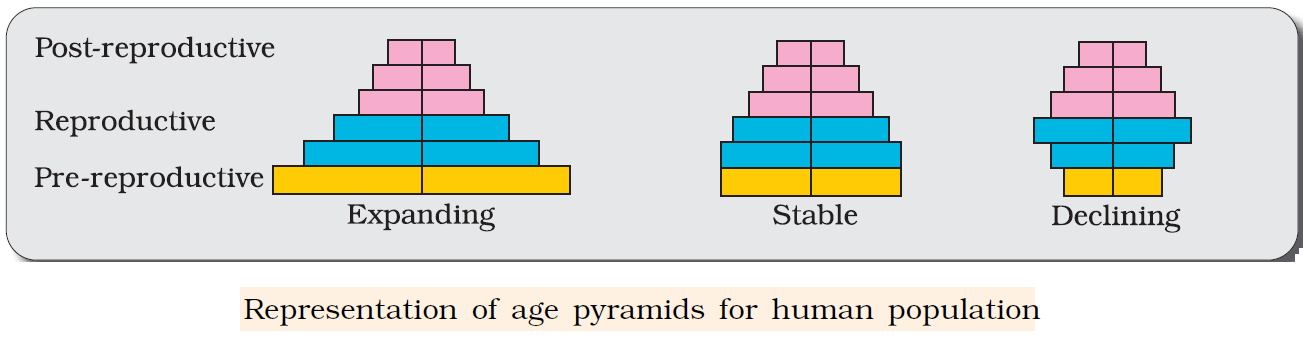
  • A population at any given time is composed of individuals of different ages. If the age distribution (per cent individuals of a given age or age group) is plotted for the population, the resulting structure is called an age pyramid. For human population, the age pyramids generally show age distribution of males and females in a combined diagram. The shape of the pyramids reflects the growth status of the population (a) whether it is growing, (b) stable or (c) declining.

Need a full question paper?

Generate a complete, print-ready paper with questions like this in minutes — across 16+ boards, with answer keys.
Start Generating Free

Similar questions

What is mycorrhiza? Write its main advantages.
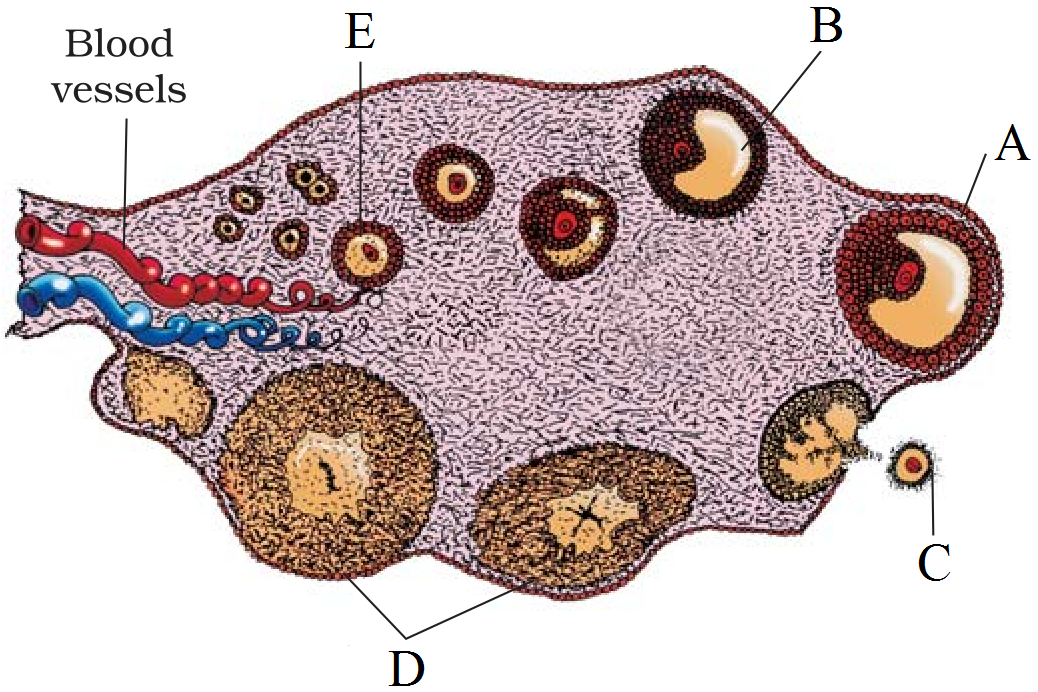
  1. Given below is the TS of human ovary. Identify the following in the diagram:
  • Corpus luteum.
  • Secondary oocyte.
  • Antrum.
  • Primary follicle.
  • Primary oocyte.
  1. Explain the changes the primary oocyte undergoes while in different follicular stages before ovulation.

​​​​​​​

Peer pressure plays a negative role in triggering smoking habits in adolescents. As a school captain, list any two activities you would like to organise with the help of senior students of your school and any other two activities you would like your school authorities to organise for the students to tackle this problem. Explain how these activities will help in doing so.
Read the following and answer any four questions from (i) to (v) given below:

Gene therapy is the technique of genetic engineering to replace a faulty gene by a normal healthy functional gene. It is a way of treating genetic disease by introducing a piece of DNA into the cells of an affected individual. Liposomes can be used for gene therapy as they target the cells affected by a genetic disease.

  1. A patient suffers from adenosine deaminase (ADA) deficiency, an autosomal recessive immune deficiency in which bone marrow lymphoblasts cannot replicate to generate immuno-competent lymphocytes. The treatment option that would cure the patient is:
  1. Germ-line gene therapy to replace one ADA gene copy.
  2. Germ-line gene therapy to replace both ADA gene copies.
  3. Somatic cell gene therapy to replace both ADA gene copies in circulating lymphocytes.
  4. Somatic cell gene therapy to replace one ADA gene copy in bone marrow lymphoblasts.
  1. Which type of gene therapy is least effective in transferring DNA to the nucleus?
  1. Adenoviruses.
  2. DNA attached to a ligand.
  3. Liposomes.
  4. Retroviruses.
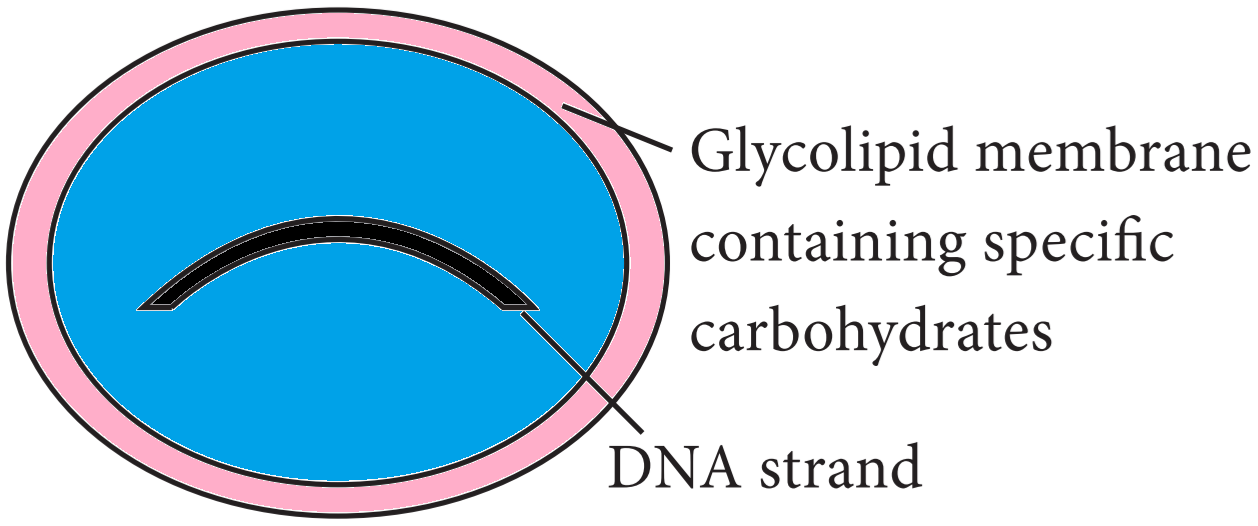
  1. Liposomes can be used for gene therapy as they target the cells affected by a genetic disease. The diagram shows the structure of a liposome.

What feature of a cell surface membrane allows the liposome to target cells affected by a genetic disease? 

  1. Carrier molecules.
  2. Phosphate groups.
  3. Protein channels.
  4. Receptor molecules.
  1. Which of the following disorders would gene therapy be least effective?
  1. Cystic fibrosis.
  2. Huntington's disease.
  3. Sickle cell anaemia.
  4. Type II diabetes.
  1. Following are some reasons explaining why gene therapy is not yet fully an effective treatment for genetic diseases.
  1. Lack of knowledge of DNA sequences.
  2. Lack of efficient and safe gene delivery system.
  3. Cost of the technology.
  4. Some diseases involve multiple genes.
  5. Problems with appropriate gene regulation.

Select the correct option. 

  1. I, III and V only
  2. II, IV and V only
  3. Ill, IV and V only
  4. I, III and IV only
Compare the life style of people living in the urban areas with those of rural areas and briefly describe how the life style affects their health.
(a) It is supposed that IUDs are effective contraceptive devices. Write names of any two commonly used IUDs and mention their mechanism of action.
(b) When the married couples are advised for sterilization? How it is carried out in male and female humans, respectively?
  1. A true breeding pea plant, homozygous for inflated green pods is crossed with another pea plant with constricted yellow pods (ffgg). What would be the phenotype and genotype of F1 and F2 generations? Give the phenotype ratio of generation.
  2. State the generalisation proposed by Mendel on the basis of the above–Mentioned cross.
  1. How do organic farmers control pests? Give two examples.
  2. State the difference in their approach from that of conventional pest control methods.
Explain the development of a secondary oocyte (ovum) in a human female from the embryonic stage upto its ovulation. Name the hormones involved in this process.

OR

When does oogenesis start in humans? Name the three hormones and their sources, linked with oogenesis. How do they influence the process of oogenesis? Explain.

  1. Mention the contributions of the following scientists:
  1. Maurice Wilkins and Rosalind Franklin.
  2. Erwin Chargaff.
  1. Draw a double-stranded dinucleotide chain with all the four nitrogen bases. Label the polarity and the components of the dinucleotide.