MCQ
An infinitely long, straight conductor $AB$ is fixed and a current is passed through it. Another movable straight wire $CD$ of finite length and carrying current is held perpendicular to it and released. Neglect weight of the wire
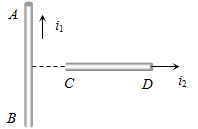
  • A
    The rod $CD$ will move upwards parallel to itself
  • B
    The rod $CD$ will move downward parallel to itself
  • The rod $C D$ will move upward and turn clockwise at the same time
  • D
    The rod $C D$ will move upward and turn anti$-$clockwise at the same time

Answer

Correct option: C.
The rod $C D$ will move upward and turn clockwise at the same time
The rod $CD$ will move upward and turn clockwise at the same time

Need a full question paper?

Generate a complete, print-ready paper with questions like this in minutes — across 16+ boards, with answer keys.

Start Generating Free

Similar questions

The ionisation potential of hydrogen atom is 13.6 volt. The energy required to remove an electron in the n = 2 state of the hydrogen atom is(a) 27.2 eV(b) 13.6 eV(c) 6.8 eV                                          (d) 3.4 eV
       
When a light wave goes from air into water,  the quality that remains unchanged is its(a) Speed                                           (b) Amplitude(c) Frequency(d) Wavelength
       
The sensitiveness of a moving coil galvanometer can be increased by decreasing(a) The number of turns in the coil(b) The area of the coil(c) The magnetic field(d) The couple per unit twist of the suspension


The magnetic compass is not useful for navigation near the magnetic poles because(a) The magnetic field near the poles is zero(b) The magnetic field near the poles is almost vertical(c) At low temperature, the compass needle looses its magnetic properties(d) Neither of the above


An ideal coil of $10$ henry is joined in series with a resistance of $5$ ohm and a battery of $5$ volt.  $2$ second after joining, the current flowing in ampere in the circuit will be
Two capacitors of capacitances 3 μF  and 6 μF  are charged to a potential of 12 V each. They are now connected to each other, with the positive plate of each joined to the negative plate of the other. The potential difference across each will be (a) 6 volt(b) 4 volt(c) 3 volt (d) Zero
       
A wire in the form of a square of side $'a\ '$ carries a current $i$. Then the magnetic induction at the centre of the square wire is $($Magnetic permeability of free space $= \mu_0 )$
A diode as a rectifier changes :
A current carrying loop is free to turn in a uniform magnetic field. The loop will then come into equilibrium when its plane is inclined at(a) 0° to the direction of the field(b) 45 ° to the direction of the field(c)  90° to the direction of the field(d) 135° to the direction of the field
   
   
A bar $-$ magnet of the pole-strength $2 Amp - m$ is kept in a magnetic field of induction $4 \times 10^{-5} Wb / m ^2$ such that the axis of the magnet makes an angle $30^{\circ}$ with the direction of the field. If the couple acting on the magnet is found to be $80 \times 10^{-7} Nm$, then the distance between the poles of the magnet is: