Question

An infinitely long, straight conductor AB is fixed and a current is passed through it. Another movable straight wire CD of finite length and carrying current is held perpendicular to it and released. Neglect weight of the wire
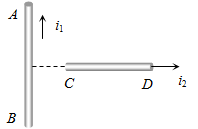
(a) The rod CD will move upwards parallel to itself

(b) The rod CD will move downward parallel to itself

(c) The rod CD will move upward and turn clockwise at the same time

(d) The rod CD will move upward and turn anti –clockwise at the same time

Answer

(c) The rod CD will move upward and turn clockwise at the same time

Need a full question paper?

Generate a complete, print-ready paper with questions like this in minutes — across 16+ boards, with answer keys.

Start Generating Free

Similar questions

Kinetic energy with which the electrons are emitted from the metal surface due to photoelectric effect is

(a) Independent of the intensity of illumination

(b) Independent of the frequency of light

(c) Inversely proportional to the intensity of illumination

(d) Directly proportional to the intensity of illumination

A square coil of area $10^{-2} m^2$ is kept perpendicular in a magnetic field of intensity $10^3 Wb / m ^2$. The magnitude of magnetic flux passing through the square is :
In the hysteresis cycle, the value of H needed to make the intensity of magnetism zero is called:

A man runs towards a mirror at a speed 15 m/s  The speed of the image relative to the man is

(a) 15  

(b) 30  

(c) 35

(d) 20

The magnetic induction at a point P which is distant 4 cm from a long current carrying wire is . The field of induction at a distance 12 cm from the same current would be

(a) 3.33

(b) 1.11

(c) 3

(d) 9

Metallic solids are always opaque because

(a) Solids effect the incident light

(b) Incident light is readily absorbed by the free electron in a metal

(c) Incident light is scattered by solid molecules

(d) Energy band traps the incident light

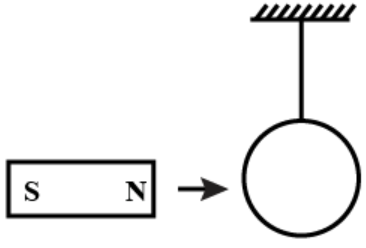
A copper ring is suspended by a thread in a vertical plane. If one end of a magnet is brought horizontally towards the ring in plane of ring as shown, the ring will.
Image
A magnetic dipole is acted upon by two magnetic fields which are inclined to each other at an angle of 75° One of the fields has a magnitude of 15 mT. The dipole attains stable equilibrium at an angle of 30° with this field. The magntidue of the other field (in mT) is close to:

A charge particle is free to move in an electric field. It will travel

(a) Always along a line of force

(b) Along a line of force, if its initial velocity is zero

(c) Along a line of force, if it has some initial velocity in the direction of an acute angle with the line of force

(d) None of the above

Resistance of a circuit is $12 \Omega$ and impedance is $15 \Omega$. The power factor of the circuit is :