MCQ
An interference pattern was made by using red light. If the red light changes with blue light, the fringes will become
  • A
    Wider
  • Narrower
  • C
    Fainter
  • D
    Brighter

Answer

Correct option: B.
Narrower
b
(b)$\beta = \frac{{\lambda D}}{d} \Rightarrow \beta \propto \lambda $

Need a full question paper?

Generate a complete, print-ready paper with questions like this in minutes — across 16+ boards, with answer keys.
Start Generating Free

Similar questions

An open pipe is in resonance in its $2^{nd}$ harmonic with tuning fork of frequency ${f_1}$. Now it is closed at one end. If the frequency of the tuning fork is increased slowly from ${f_1}$ then again a resonance is obtained with a frequency ${f_2}$. If in this case the pipe vibrates ${n^{th}}$ harmonics then
A rigid diatomic ideal gas undergoes an adiabatic process at room temperature. The rational between temperature and volume for the process is $TV^x =$ constant, then $x$ is
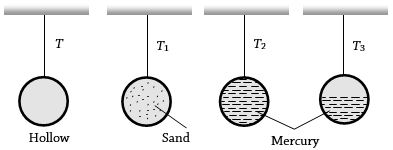
The period of a simple pendulum, whose bob is a hollow metallic sphere, is $T$.The period is $T_1$ when the bob is filled with sand, $T_2$ when it is filled with mercury and $T_3$ when it is half filled with mercury. Which of the following is true
Three equal charges $+q$ are placed at the three vertices of an equilateral triangle centred at the origin. They are held in equilibrium by a restoring force of magnitude $F(r)=k r$ directed towards the origin, where $k$ is a constant. What is the distance of the three charges from the origin?
One end of string of length $l$ is connected to a particle of mass $'m'$ and the other end is connected to a small peg on a smooth horizontal table. If the particle moves in circle with speed $'v',$ the net force on the particle (directed towards centre) will be ($T$ represents the tension in the string) 
Three samples of the same gas $A, B$ and $C(\gamma = 3/2)$ have initially equal volume. Now the volume of each sample is doubled. The process is adiabatic for $A$ isobaric for $B $ and isothermal for $C$. If the final pressures are equal for all three samples, the ratio of their initial pressures are
The pressure and volume of saturated water vapour are $P$ and $V$ respectively. It is compressed isothermally thereby volume becomes $V/2,$ the final pressure will be
${v_e}$ and ${v_p}$ denotes the escape velocity from the earth and another planet having twice the radius and the same mean density as the earth. Then
Consider a binary star system of star $A$ and star $B$ with masses $m_{A}$ and $m_{B}$ revolving in a circular orbit of radii $r_{A}$ and $r_{B}$, respectively. If $T_{A}$ and $T_{B}$ are the time period of star $A$ and star $B$, respectively, then -
A rubber pipe of density $1.5 \times {10^3}\,N/{m^2}$ and Young's modulus $5 \times {10^6}\,N/{m^2}$ is suspended from the roof. The length of the pipe is $8 \,m$. What will be the change in length due to its own weight