MCQ
An ion $M^{2+},$ forms the complexes $[M(H_2O)_6]^{2+} , [M(en)_3]^{2+}$ and $[MBr_6]^{4-},$ match the complex with the appropriate colour.
- AGreen, blue and red
- ✓Blue, red and green
- CGreen, red and blue
- DRed, blue and green
the ligand is a strong field ligand More will be the value of $\Delta_{o}$ and lower will be its wavelength. Among the given complexes the strength of ligands are $B r^{-} colours are red, green, blue the absorbed colours must be green,red,orange. Hence the compound $\left[M\left(H_{2} O\right)_{6}\right]^{2+},\left[M(e n)_{3}\right]^{2+},\left[M(B r)_{6}\right]^{4-}$ are blue red and green respectively. Hence option $B$ is correct.
Generate a complete, print-ready paper with questions like this in minutes — across 16+ boards, with answer keys.
$(A)$ $\Lambda \stackrel{0}{ m }$ for electrolyte $A$ is obtained by extrapolation
$(B)$ For electrolyte B, vx $\Lambda m$ vs $\sqrt{ c }$ graph is a straight line with intercept equal to $\Lambda \stackrel{0}{ m }$
$(C)$ At infinite dilution, the value of degree of dissociation approach zero for electrolyte $B$.
$(D)$ $\Lambda \stackrel{0}{ m }$ for any electrolyte $A$ or $B$ can be calculated using $\lambda^{\circ}$ for individual ions.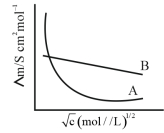
$A$ || $B$