MCQ
An ionization chamber with parallel conducting plates as anode and cathode has $5 \times 10^7$ electrons and the same number of singly-charged positive ions per $\mathrm{cm}^3$. The electrons are moving at 0.4 m/s. The current density from anode to cathode is $4 \mu \mathrm{A} / \mathrm{m}^2$. The velocity of positive ions moving towards cathode is
  • A
    0.4 m/s
  • B
    16 m/s
  • C
    Zero
  • 0.1 m/s

Answer

Correct option: D.
0.1 m/s
(d) 0.1 m/s

Need a full question paper?

Generate a complete, print-ready paper with questions like this in minutes — across 16+ boards, with answer keys.

Start Generating Free

Similar questions

An electron of mass m and charge q is travelling with a speed v along a circular path of radius r at right angles to a uniform of magnetic field B. If speed of the electron is doubled and the magnetic field is halved, then resulting path would have a radius of
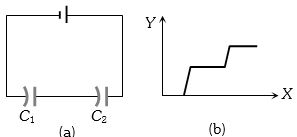
Figure $(A)$ shows two capacitors connected in series and joined to a battery. The graph in figure $(B)$ shows the variation in potential as one moves from left to right on the branch containing the capacitors, if
If the shift of wavelength of light emitted by a star is towards violet, then this shows that star is
The retarding potential for having zero photo-electron current
The electric field in a certain region is acting radially outward and is given by $E =Ar.$ A charge contained in a sphere of radius $'a'$ centred at the origin of the field, will be given by
Consider a metallic cube of edge length $L$. Its resistance, $R$, measured across its opposite faces is $R =\frac{ m _{ e } v }{ ne ^2 L ^2}$, where $n$ is the number density and $v$ is the drift speed of electrons in the cube, and $e$ and $m _{ e }$ are the charge and mass of an electron respectively. Assuming the de-Broglie wavelength of the electron to be $L$, the maximum resistance of the sample is closest to ............. $\,\Omega$ $\left(e=1.60 \times 10^{-19} \,C ; m _{ e }=9.11 \times 10^{-31} \,kg\right.$; Planck's constant, $h=6.63 \times 10^{-34} \,Js$ )
Relation between current $I$ flowing in moving coil galyanometer and deflection $\theta$ is :
The activity of a radioactive sample
This question has Statement $-1$ and Statement $-2$ Of the four choices given after the Statements, choose the one that best describes the two Statements

Statement $1$ : No work is required to be done to move a test charge between any two points on an equipotential surface

Statement $2$ : Electric lines of force at the equipotential surfaces are mutually perpendicular to each other

A set of atoms in an excited state decay.