MCQ
An isolated solid metallic sphere is given +Q charge. The charge will be distributed on the sphere
  •  Uniformly but only on surface
  • B
    Only on surface but non-uniformly
  • C
     Uniformly inside the volume
  • D
     Non-uniformly inside the volume

Answer

Correct option: A.
 Uniformly but only on surface
 Uniformly but only on surface

Need a full question paper?

Generate a complete, print-ready paper with questions like this in minutes — across 16+ boards, with answer keys.
Start Generating Free

Similar questions

Current is flowing in a circular coil of radius r. There are n turns in the coil. Its magnetic moment varies with r. As:
A star moves away from earth at speed $0.8 c$ while emitting light of frequency $6 \times {10^{14}}Hz$. What frequency will be observed on the earth (in units of $10^{14}\, Hz$) ($c = $ speed of light)
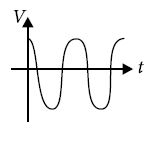
The voltage across a pure inductor is represented by the following diagram. Which of the following diagram will represent the current 
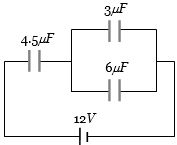
In the circuit shown in the figure, the potential difference across the $4.5\,\mu F$ capacitor is.......$volts$
A metallic sphere has a charge of $10\,\mu C$. A unit negative charge is brought from $A$ to $B$ both $100\,cm$ away from the sphere but $A$ being east of it while $B$ being on west. The net work done is........$joule$
The unit of focal power of a lens is
From a newly formed radioactive substance (Half life 2 hours), the intensity of radiation is 64 times the permissible safe level. The minimum time after which work can be done safely from this source is
An electron makes a transition from orbit n = 4 to the orbit n = 2 of a hydrogen atom. The wave number of the emitted radiations (R = Rydberg's constant) will be
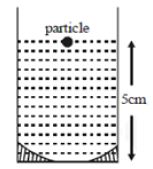
A concave mirror has radius of curvature of $40\, cm$. It is at the bottom of a glass that has water filled up to $5\, cm$ (see figure). If a small particle is floating on the surface of water, its image as seen, from directly above the glass, is at a distance $d$ from the surface of water. The value of $d$ is close to ......$cm$ (Refractive index of water $= 1.33$)
A radioactive substance has a half life of 60 minutes. After 3 hours, the fraction of atom that have decayed would be