Question
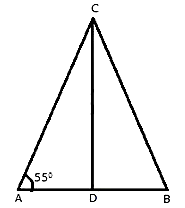
An isosceles $\triangle A B C$ has $A C=B C. C D$ bisects $A B$ at $D$ and $\angle C A B=55^{\circ}$.Find:$(i) \angle DCB;(ii) \angle CBD.$
Answer


In $\triangle \mathrm{ABC}$,
$A C=B C\dots.......[$Given$]$
$\therefore \angle C A B=\angle C B D\dots........[$angles opp.to equal sides are equal$]$
$\Rightarrow \angle C B D=55^{\circ}$
In $\triangle \mathrm{ABC}$,
$ \angle \mathrm{CBA}+\angle \mathrm{CAB}+\angle \mathrm{ACB}=180^{\circ}$
but,$\angle \mathrm{CAB}=\angle \mathrm{CBA}=55^{\circ}$
$\Rightarrow 55^{\circ}+55^{\circ}+\angle \mathrm{ACB}=180^{\circ}$
$\Rightarrow \angle \mathrm{ACB}=180^{\circ}-110^{\circ}$
$\Rightarrow \angle \mathrm{ACB}=70^{\circ}$
Now,
In $\triangle A C D$ and $\triangle B C D$,
$ \mathrm{AC}=\mathrm{BC} \ldots . . .[$ Given$]$
$\mathrm{CD}=\mathrm{CD} \ldots . . . .[$ Common$]$
$\mathrm{AD}=\mathrm{BD} \ldots . . . .[$ Given: $\mathrm{CD}$ bisects $\mathrm{AB}]$
$\therefore \triangle \mathrm{ACD} \cong \triangle \mathrm{BCD}$
$\Rightarrow \angle \mathrm{DCA}=\angle \mathrm{DCB}$
$\Rightarrow \angle \mathrm{DCB}=\frac{\angle \mathrm{ACB}}{2}=\frac{70^{\circ}}{2}$
$\Rightarrow \angle \mathrm{DCB}=35^{\circ} .$

Need a full question paper?

Generate a complete, print-ready paper with questions like this in minutes — across 16+ boards, with answer keys.
Start Generating Free

Similar questions

If $\operatorname{cosec} \theta=\frac{29}{20}$, find the value of$: \operatorname{cosec} \theta-\frac{1}{\cot \theta}$
From a point $O$ in the interior of a $\triangle ABC$, perpendicular $OD, OE$ and $OF$ are drawn to the sides $BC, CA$ and $AB$ respectively. Prove that: $AF^2 + BD^2 + CE^2 = AE^2 + CD^2 + BF^{2 }$
Prove that the following number is irrational: $\sqrt{5 }- 2$
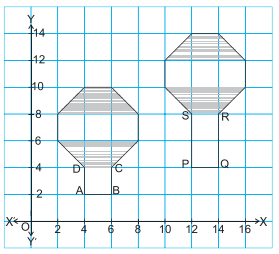
Saumya studies in class IX. One day, she drew the sketch of table tennis racket on a graph paper, as shown alongside. Observe these sketches and answer the questions given below :
Q.1. The distance of the point S from y-axis is :
(a) 10 units (b) 8 units (c) 6 units (d) 12 units
Q.2. The distance between the points D and R is :
(a) 116 units (b) $\sqrt{116}$ units (c) $2 \sqrt{30}$ units (d) $29 \sqrt{2}$ units
Q.3. The length of diagonal SQ is :
(a) $5 \sqrt{2}$ units (b) $2 \sqrt{3}$ units (c) $2 \sqrt{5}$ units (d) $2 \sqrt{7}$ units
Q.4. ABCD is a :
(a) square (b) rectangle (c) rhombus (d) kite
Q.5. PQRS is a :
(a) square (b) rectangle (c) rhombus (d) kite
Image
The total surface area of a cylinder is $3872 \ cm^2$. Find its height and volume if the circumference of the base is $88 \ cm .$
A shopkeeper allows two successive discounts of $10\%$ and $15\%$ on his articles. If he gets $Rs.2295$ for an article, find its marked price.
Prove that: $\frac{1}{\log _8 36}+\frac{1}{\log _9 36}+\frac{1}{\log _{18} 36}=2$
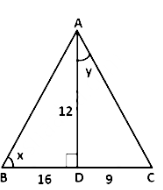
In the given figure $,AD$ is perpendicular to $BC.$ Find $: 5 \cos x$
Image
In a two$-$digit number, the sum of the digits is 7$$. The difference of the number obtained by reversing the digits and the number itself is $9$. Find the number.
Arrange $\frac{5}{8},-\frac{3}{16},-\frac{1}{4}$ and $\frac{17}{32}$ in descending order of their magnitudes.Also, find the sum of the lowest and largest of these fractions. Express the result obtained as a decimal fraction correct to two decimal places.