MCQ
An N-type semiconductor is:
- Anegatively charged
- Bpositively charged
- ✓insulator
- Dnone of these
Generate a complete, print-ready paper with questions like this in minutes — across 16+ boards, with answer keys.
In an amplitude modulated wave for audio frequency of 500 cycle/second, the appropriate carrier frequency will be
|
(a) 50 cycles/sec |
(b) 100 cycles/sec |
(c) 500 cycles/sec |
(d) 50,000 cycles/sec |
A conducting loop carrying a current I is placed in a uniform magnetic field pointing into the plane of the paper as shown. The loop will have a tendency to

|
(a) Contract |
(b) Expand |
|
(c) Move towards +ve x –axis |
(d) Move towards –ve x-axis |
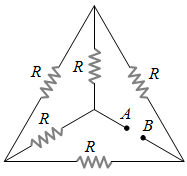
If each of the resistance of the network shown in the figure is R, the equivalent resistance between A and B is
|
(a) 5 R |
(b) 3 R |
(c) R |
(d) R/2 |
NPN transistor are preferred to PNP transistor because they have
|
(a) Low cost |
|
(b) Low dissipation energy |
|
(c) Capability of handing large power |
|
(d) Electrons having high mobility than holes |
A proton is accelerated through 50,000 V. will increase Its energy by
|
(a) 5000 eV |
(b) 8 |
(c) 5000 J |
(d) 50,000 J |
Unpolarized light of intensity 32Wm–2 passes through three polarizers such that transmission axes of the first and second polarizer makes and angle 30° with each other and the transmission axis of the last polarizer is crossed with that of the first. The intensity of final emerging light will be
|
(a) 32 Wm–2 |
(b) 3 Wm–2 |
(c) 8 Wm–2 |
(d) 4 Wm–2 |
A nucleus with mass number 220 initially at rest emits an a-particle. If the Q value of the reaction is 5.5 MeV, calculate the kinetic energy of the a-particle
|
(a) 4.4 MeV |
(b) 5.4 MeV |
(c) 5.6 MeV |
(d) 6.5 MeV |
The refractive index of a certain glass is 1.5 for light whose wavelength in vacuum is 6000 Å. The wavelength of this light when it passes through glass is
|
(a) 4000 Å |
(b) 6000 Å |
(c) 9000 Å |
(d) 15000 Å |
The chromatic Aberration in lenses becomes due to
|
(a) Disimilarity of main axis of rays |
|
(b) Disimilarity of radii of curvature |
|
(c) Variation of focal length of lenses with wavelength |
|
(d) None of these |
