MCQ
An object falling through a fluid is observed to have acceleration given by $a = g -bv$ where $g =$ gravitational acceleration and $b$ is constant. After a long time of release, it is observed to fall with constant speed. The value of constant speed is
  • $\frac{g}{b}$
  • B
    $\frac{b}{g}$
  • C
    $bg$
  • D
    $b$

Answer

Correct option: A.
$\frac{g}{b}$
a
Here, $a=g-b v$

When an object falls with constant speed $v_{c},$ its

acceleration becomes zero.

$\mathrm{g}-\mathrm{bv}_{\mathrm{c}}=0 \text { or } \mathrm{v}_{\mathrm{c}}=\frac{\mathrm{g}}{\mathrm{b}}$

Need a full question paper?

Generate a complete, print-ready paper with questions like this in minutes — across 16+ boards, with answer keys.

Start Generating Free

Similar questions

Activity of a radioactive substance can be represented by various unit. Select correct option
A coil has $1,000$ turns and $500\, cm^2$ as its area. The plane of the coil is placed at right angles to a magnetic induction field of $2 \times {10^{ - 5}}\,Wb/{m^2}$. The coil is rotated through ${180^o}$ in $0.2$ seconds. The average $e.m.f$. induced in the coil, in milli-volts, is
A siren placed at a railway platform is emitting sound of frequency $5 kHz$. A passenger sitting in a moving train $A$ records a frequency of $5.5 kHz$ while the train approaches the siren. During his return journey in a different train $B$ he records a frequency of $6.0 kHz$ while approaching the same siren. The ratio of the velocity of train $B$ to that of train $A$ is
There are $10^{10}$ radioactive nuclei in a given radioactive element, Its half-life time is $1\, minute.$ How many nuclei will remain after $30\, seconds?$

$(\sqrt{2}=1.414)$

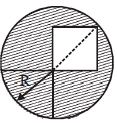
From a circular disc of radius $R$, a square is cut out with a radius as its diagonal. The center of mass of remainder part is at a distance (from the centre)
A wire of density $9 \times 10^{-3} \,kg\, cm ^{-3}$ is stretched between two clamps $1\, m$ apart. The resulting strain in the wire is $4.9 \times 10^{-4}$. The lowest frequency of the transverse vibrations in the wire is......$HZ$

(Young's modulus of wire $Y =9 \times 10^{10}\, Nm ^{-2}$ ), (to the nearest integer),

Which one of the following is dimensionless physical quantity?
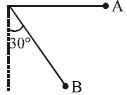
A simple pendulum is released from $A$ as shown in figure. If $m$ and $l$ represent the mass of the bob and the length of the pendulum respectively, the gain in kinetic energy at $B$ is
In case of a simple pendulum, time period versus length is depicted by
Energy required for the electron excitation in $Li^{++}$ from the first to the third Bohr orbit is.....$eV$