MCQ
An object falling through a fluid is observed to have acceleration given by $a = g -bv$ where $g =$ gravitational acceleration and $b$ is constant. After a long time of release, it is observed to fall with constant speed. The value of constant speed is
  • $\frac{g}{b}$
  • B
    $\frac{b}{g}$
  • C
    $bg$
  • D
    $b$

Answer

Correct option: A.
$\frac{g}{b}$
a
Here, $a=g-b v$

When an object falls with constant speed $v_{c},$ its

acceleration becomes zero.

$\mathrm{g}-\mathrm{bv}_{\mathrm{c}}=0 \text { or } \mathrm{v}_{\mathrm{c}}=\frac{\mathrm{g}}{\mathrm{b}}$

Need a full question paper?

Generate a complete, print-ready paper with questions like this in minutes — across 16+ boards, with answer keys.

Start Generating Free

Similar questions

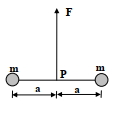
Two particle of mass $m$ each are tied at the ends of a light string of length $2 \mathrm{a}$. The whole system is kept on a frictionless horizontal surface with the string held tight so that each mass is at a distance $'a'$ from the center $\mathrm{P}$ (as shown in the figure). Now, the mid-point of the string is pulled vertically upwards with a small but constant force $F$. As a result, the particles move towards each other on the surface. The magnitude of acceleration, when the separation between them becomes $2 \mathrm{x}$ is
An ideal gas has molecules with $5\,$ degrees of freedom. The ratio of specific heats at constant pressure $(C_p)$ and at constant volume $(C_v)$ is
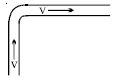
A fire hydrant delivers water of density $\rho$ at a volume rate $L$. The water travels vertically upward through the hydrant and then does $90^o $ turn to emerge horizontally at speed $V$. The pipe and nozzle have uniform crosssection throughout. The force exerted by the water on the corner of the hydrant is
Diatomic molecules like hydrogen have energies due to both translational as well as rotational motion. From the equation in kinetic theory $\text{PV} = \frac{2}{3}$ E,E is:
Which of the following quantities does not depend upon the orbital radius of the satellite
When a satellite moves around the earth in a certain orbit, the quantity which remains constant is .........
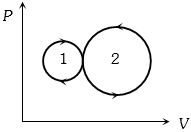
In the following indicator diagram, the net amount of work done will be
Match the type of elasticity involved
  $(i)$ Suspension fibre of galvanometer  $(a)$ Linear
  $(ii)$ Bending of beam  $(b)$ Shear
  $(iii)$ cutting piece of paper  $(c)$ Bulk
  $(iv)$ mechanical waves in fluid  $(d)$ Shear
 The specific heat capacity of solids is given by:
The value of coefficient of volume expansion of glycerin is $5 \times 10^{-4} K^{-1}$. The fractional change in the density of glycerin for a rise of $40^{\circ} C$ in its temperature, is