Question
An object is 24cm away from a concave mirror and its image is 16cm from the mirror. Find the focal length and radius of curvature of the mirror, and the magnification of the image.

Answer

u = -24cm
v = -16cm
f = ?, m = ?
We know that
$\frac{1}{\text{v}}+\frac{1}{\text{u}}=\frac{1}{\text{f}}$
$\frac{1}{-16}+\frac{1}{-24}=\frac{1}{\text{f}}$
$\frac{-5}{48}=\frac{1}{\text{f}}$
$\text{R}=2\text{f}$
$=2\times-9.6=-19.2\text{cm}$
$\text{m}=-\frac{\text{v}}{\text{u}}$
$\text{m}=-\frac{-16}{-24}$
$\text{m}=-0.666$

Need a full question paper?

Generate a complete, print-ready paper with questions like this in minutes — across 16+ boards, with answer keys.

Start Generating Free

Similar questions

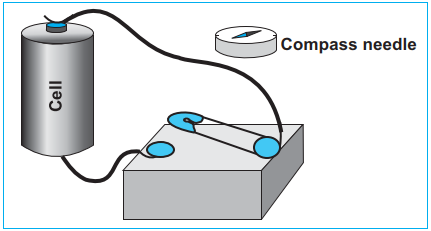
Make a circuit by connecting the two terminals of the electric cell to the key as shown in the fig. 5.13. Place the compass needle close to it. Note carefully the direction in which the compass needle is pointing, close the key for few seconds. Release the key and watch again. Repeat the steps again by changing its polarity. Record the observations.
Image

(i) Why does the needle get deflected when the key is pressed?
(ii) Connect two battery cells in series to the two ends of the wire and now form the key. What do you observe?
State Newlands’ law of octaves.
Explain how, geothermal energy is used to generate electricity.
Read the following paragraph and answer the questions based on it:
If heat is exchanged between a hot and cold object, the temperature of the cold object goes on increasing due to gain of energy and the temperature of the hot object goes on decreasing due to loss of energy.
The change in temperature continues till the temperatures of both the objects attain the same value. In this process, the cold object gains heat energy and the hot object loses heat energy. If the system of both the objects is isolated from the environment by keeping it inside a heat resistant box, then no energy can flow from inside the box or come into the box.

i. Heat is transferred from where to where?
ii. Which principle do we learn about from this process?
iii. How will you state the principle briefly?
Write the names from the description.
(i) The period with electrons in the shell, K, L and M.
(ii) The group with valency zero.
(iii) The family of nonmetals having valency one.
(iv) The family of metals having valency one.
(v) The family of metals having valency two.
(vi) The metalloids in the second and third periods.
(vii) Non-metals in the third period.
(viii) Two elements having valency 4.
A coil is connected to a galvanometer. When the N-pole of magnet is pushed into the coil, the galvanometer deflected to the right. What deflection, if any, is observed when:
  1. The N-pole is removed?
  2. The S-pole is inserted?
  3. The magnet is a rest in the coil?
Draw a neat labelled diagrams: One solar panel produces a potential difference of 18 V and current of 3A. Describe how you can obtain a potential difference of 72 Volts and current of 9 A with a solar array using solar panels. You can use sign of a battery for a solar panel.
What is the difference between autotrophic nutrition and heterotrophic nutrition?
State the formulae for the refractive index of the second medium with respect to the first medium.
In what respects do the properties of group 1 elements differ from those of group 17 elements? Explain with examples by taking one element from each group.