Question
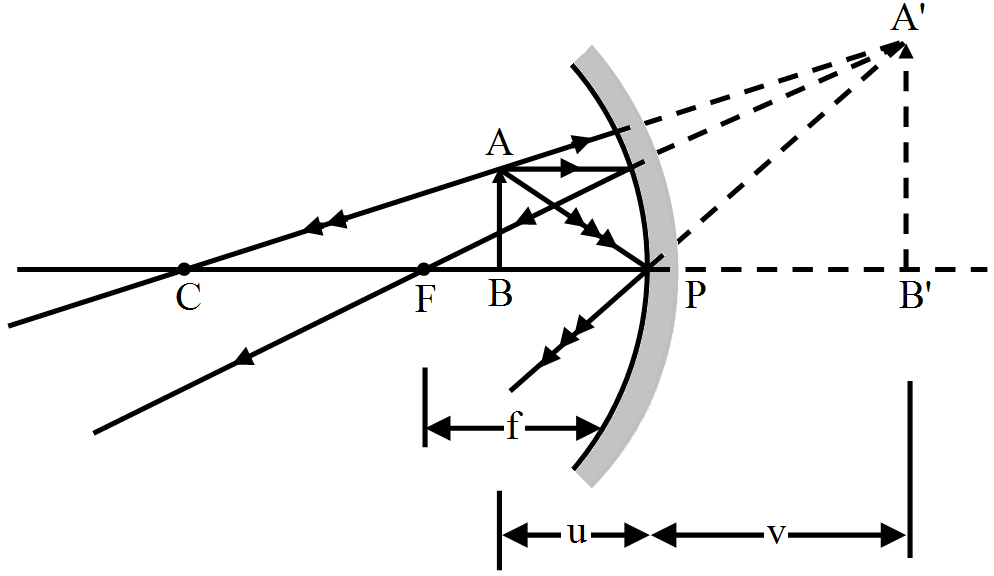
  1. An object is placed in front of a concave mirror. It is observed that a virtual image is formed. Draw the ray diagram to show the image formation and hence derive the mirror equation $\frac{1}{\text{f}}=\frac{1}{\text{u}}+\frac{1}{\text{v}}.$
  2. An object is placed 30cm in front of a plano-convex lens with its spherical surface of radius of curvature 20cm. If the refractive index of the material of the lens is 1.5, find the position and nature of the image formed.

Answer

  1.  

$\triangle\text{ABC}\sim\triangle\text{A}_1\text{B}_1\text{C}$

$\Rightarrow\frac{\text{A}_1\text{B}_1}{\text{AB}}=\frac{\text{A}_1\text{C}}{\text{AC}}=\frac{(+\text{v})+(-\text{R)}}{(-\text{R})-(-\text{u)}}\ ...(1)$

$\triangle\text{ABP}\sim\triangle\text{A}_1\text{B}_1\text{P}$

$\Rightarrow\frac{\text{A}_1\text{B}_1}{\text{AB}}=\frac{\text{A}_1\text{P}}{\text{AP}}=\frac{+\text{v}}{-\text{u}}\ ...(2)$

$(1)=(2)$

$\Rightarrow\frac{\text{v}-\text{R}}{-\text{R}+\text{u}}=\frac{\text{v}}{-\text{u}}$

$\Rightarrow-\text{uv}+\text{uR}=-\text{vR}+\text{uv}$

$\Rightarrow\text{uR}+\text{vR}=2\text{uv}$

$\div\text{ by }\text{uvR}$

$\Rightarrow\frac{1}{\text{v}}+\frac{1}{\text{u}}=\frac{2}{\text{R}}$

$\because\text{R}=2\text{F}$

$\therefore\frac{1}{\text{v}}+\frac{1}{\text{u}}=\frac{1}{\text{f}}$

  1. $\frac{1}{\text{f}}=(1.5-1)\Big(\frac{1}{20}-\frac{1}{\infty}\Big)$

$=\frac{0.5}{20}=\frac{5}{200}=\frac{1}{40}$

$\therefore\text{f}=40\text{cm}$

Now, $\frac{1}{\text{f}}=\frac{1}{\text{v}}-\frac{1}{\text{v}}$

$\Rightarrow\text{v}=\frac{\text{fu}}{\text{f}+\text{u}}=\frac{40\times-30}{40-30}$

$\Rightarrow\text{v}=\frac{-40\times30}{10}=-120\text{cm}$

Image is virtual, erect and enlarged in front of lens 120cm away.
Need a full question paper?

Generate a complete, print-ready paper with questions like this in minutes — across 16+ boards, with answer keys.

Start Generating Free

Similar questions

Answer the following questions:
(a) Are the equations of nuclear reactions (such as those given in Section 13.7) 'balanced' in the sense a chemical equation (e.g., $2 H _2+ O _2 \rightarrow 2 H _2 O$ ) is? If not, in what sense are they balanced on both sides?
(b) If both the number of protons and the number of neutrons are conserved in each nuclear reaction, in what way is mass converted into energy (or vice-versa) in a nuclear reaction?
(c) A general impression exists that mass-energy interconversion takes place only in nuclear reaction and never in chemical reaction. This is strictly speaking, incorrect. Explain.
A light beam of wavelength 400 run is incident on a metal plate of work function 2.2eV.
  1. A particular electron absorbs a photon and makes two collisions before coming out of the metal. Assuming that 10% of the extra energy is lost to the metal in each collision, find the kinetic energy of this electron as it comes out of the metal.
  2. Under the same assumptions, find the maximum number of collisions the electron can suffer before it becomes unable to come out of the metal.
An electron is projected horizontally with a kinetic energy of 10keV. A magnetic field of strength 1.0 × 10⁻⁷T exists in the vertically upward direction.
  1. Will the electron deflect towards the right or left of its motion?
  2. Calculate the sideways deflection of the electron while travelling through 1m. Make appropriate approximations.
A ball falls on an inclined plane of inclination $\theta$ from a height h above the point of impact and makes a perfectly elastic collision. Where will it hit the plane again?
Prove that the value of energy stored in a capacitor is $\frac{1 Q^2}{2 C}$ and the energy density of the electric field is $u=\frac{1}{2} \in_0 E ^2$.
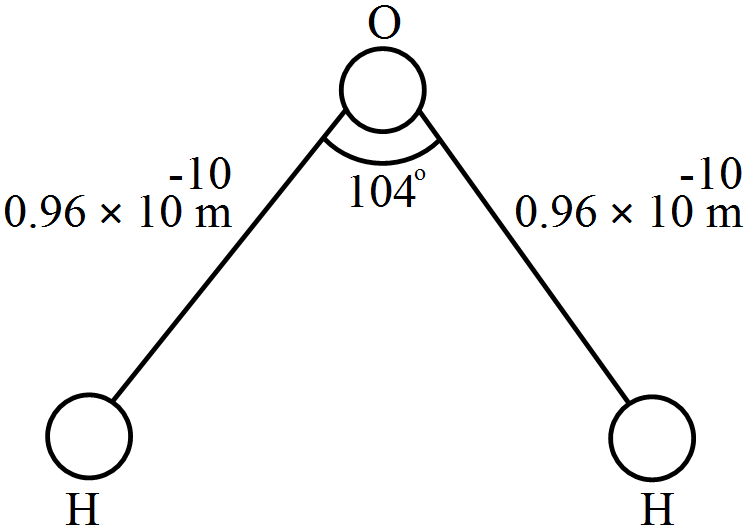
The structure of a water molecule is shown in figure. Find the distance of the centre of mass of the molecule from the centre of the oxygen atom.

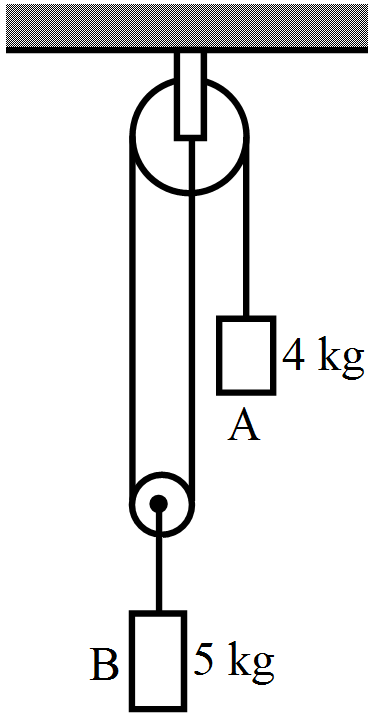
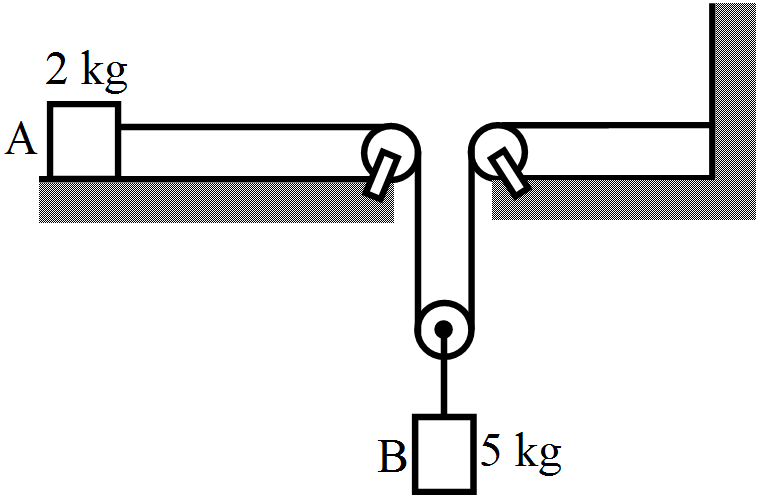
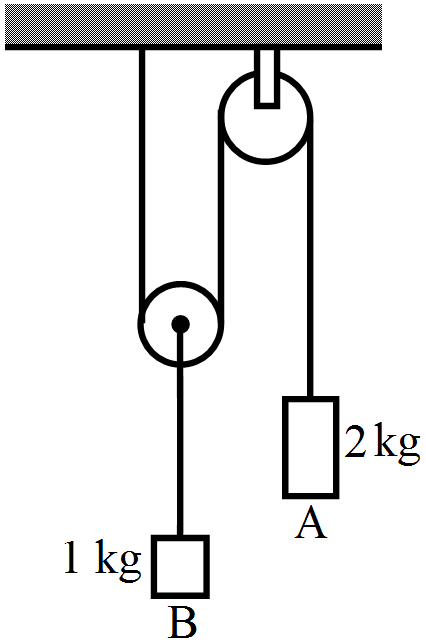
Find the acceleration of the blocks A and B in the three situations shown in figure.


Explain why elemental semiconductor cannot be used to make visible LEDs.
The volume of an ideal gas $(\gamma=1.5)$ is changed adiabatically from 4.00 litres to 3.00 litres. Find the ratio of,
  1. The final pressure to the initial pressure.
  2. The final temperature to the initial temperature.
The equation of a wave travelling on a string stretched along the X-axis is given by-

$\text{y}=\text{A}\text{e}^{-\Big(\frac{\text{x}}{\text{a}}+\frac{\text{t}}{\text{T}}\Big)^2}.$

  1. Write the dimensions of A, a and T.
  2. Find the wave speed.
  3. In which direction is the wave. travelling?
  4. Where is the maximum of the pulse located at t = T? at t = 2T?