MCQ
An object is projected horizontally with speed $\frac{1}{2} \sqrt{\frac{G M}{R}}$, from a point at height $3 R$ [where $R$ is radius and $M$ is mass of earth, then object will] 
  • A
    Fall back on surface of earth by following parabolic path
  • B
    Fall back on surface of earth by following hyperbolic path
  • Start rotating around earth in a circular orbit
  • D
    Escape from gravitational field of earth
Answer

Correct option: C.
Start rotating around earth in a circular orbit
c
(c)

At height $3 R$, i.e at distance $4 R$ from the centre of the earth,

$V_{\text {orbital }}=\sqrt{\frac{G M}{r}}$

Here, $r=4 R \Rightarrow V_0=\sqrt{\frac{G M}{4 R}}=\frac{1}{2} \sqrt{\frac{G M}{R}}$,

Thus, an object taken to a height $3 R$ if projected horizontally with speed $\frac{1}{2} \sqrt{\frac{G M}{R}}$, will start rotating around earth in a circular orbit.

Need a full question paper?

Generate a complete, print-ready paper with questions like this in minutes — across 16+ boards, with answer keys.

Start Generating Free

Similar questions

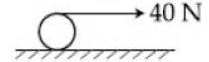
A string is wound around a hollow cylinder of mass $5\, kg$ and radius $0.5\,m$. If the string is now pulled with a horizontal force of $40\, N$, and the cylinder is rolling without slipping on a horizontal surface (see figure), then the angular acceleration of the cylinder will be ......... $rad/s^2$ .(Neglect the mass and thickness of the string)
The acceleration of a train travelling with speed of $400 \,m/s$ as it goes round a curve of radius $160\,m$, is
What is the value of $\frac{R}{{{C_P}}}$ for diatomic gas
A Carnot engine absorbs an amount $Q$ of heat from a reservoir at an abosolute temperature $T$ and rejects heat to a sink at a temperature of $T/3.$ The amount of heat rejected is
An object is projected upwards with a velocity of $100 \,m/s$. It will strike the ground after (approximately)........$sec$
A car, starting from rest, accelerates at the rate $\alpha$ through a distance $d$, then continues at a constant speed for time $t$ and then decelerates at the rate of $\alpha/2$ to come to rest. If the total distance traveled is $15\, d$, then $d=$
Consider the following two equations:
  1. $\text{L}=\text{I}\omega$
  2. $\frac{\text{dL}}{\text{dt}}=\Gamma$
In noninertial frames:
  1. Both A and Bare true.
  2. A is true but B is false.
  3. B is true but A is false.
  4. Both A and Bare false.
A weight of $200 \,kg$ is suspended by vertical wire of length $600.5\, cm$. The area of cross-section of wire is $1\,m{m^2}$. When the load is removed, the wire contracts by $0.5 \,cm$. The Young's modulus of the material of wire will be
Two particles start simultaneously from the same point and move along two straight lines, one with uniform velocity $v$ and other with a uniform acceleration $a.$ If $\alpha$ is the angle between the lines of motion of two particles then the least value of relative velocity will be at time given by
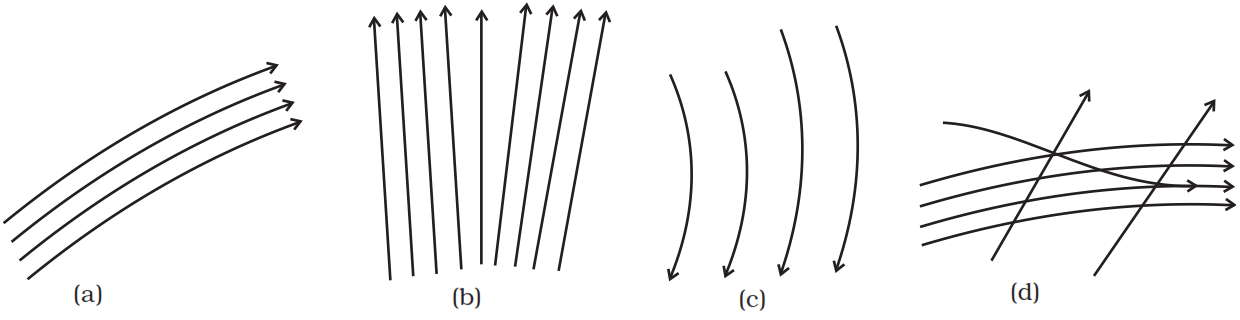
Which of the following diagrams does not represent a streamline flow?