Question
An object is rotating with uniform angular acceleration. If the rotation is started from rest state then the angular displacement after time will be proportional to what power of time?

Answer

 From the second equation of rotational motion
$\theta=\omega_0 t+\frac{1}{2} \alpha t^2$
where $\omega_0=\text { zero }$
$\therefore \quad \theta=0 \times t+\frac{1}{2} \alpha t^2$
$\theta=\frac{1}{2} \alpha t^2$
Hence, $\alpha$ is the uniform angular acceleration.
$\therefore \quad \theta \propto t^2$

Need a full question paper?

Generate a complete, print-ready paper with questions like this in minutes — across 16+ boards, with answer keys.
Start Generating Free

Similar questions

Lithium (Z = 3) has two stable isotopes 6Li and 7Li. When neutrons are bombarded on lithium sample, electrons and $\alpha$-particles are ejected. Write down the nuclear process taking place.
There are two containers of equal volume. One is filled with oxygen gas and the other is filled with hydrogen gas. If both the gases are at the same temperature then what will be the ratio of their pressures? If the ratio of their square root velocities is $1: 4$.
The bob of a simple pendulum of length 1m has mass 100g and a speed of 1.4m/s at the lowest point in its path. Find the tension in the string at this instant.
Does it matter if one uses gauge instead of absolute pressures in applying Bernoulli’s equation? Explain.
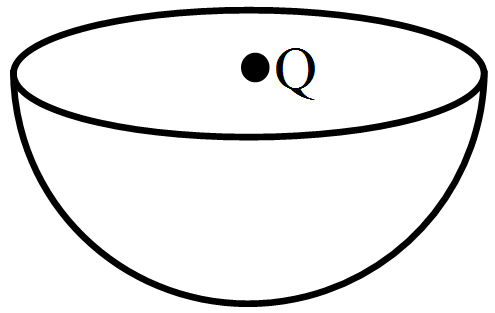
A charge Q is placed at the centre of an imaginary hemispherical surface. Using symmetry arguments and the Gauss's law, find the flux of the electric field due to this charge through the surface of the hemisphere (figure).

The weather report reads, "Temperature 20°C : Relative humidity 100%". What is the dew point?
An electron gun emits 2.0 × 10¹⁶ electrons per second. What electric current does this correspond to?
Why is the weight of a body at the poles more than the weight at the equator? Explain.
A tightly-wound, long solenoid has n turns per unit length, a radius r and carries a current i. A particle having charge q and mass m is projected from a point on the axis in a direction perpendicular to the axis. What can be the maximum speed for which the particle does not strike the solenoid ?
A liquid drop breaks into 27 small drops. If surface tension of the liquid is S, then find the energy released.