MCQ
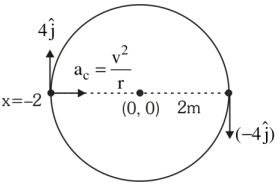
An object moves at a constant speed along a circular path in a horizontal plane with centre at the origin. When the object is at $x =+2\,m$, its velocity is $-4 \hat{ j }\, m / s$. The object's velocity $(v)$ and acceleration $(a)$ at $x =-2\,m$ will be
  • A
    $v =4 \hat{ i }\,m / s , a =8 \hat{ j }\,m / s ^2$
  • $v =4 \hat{ j }\,m / s , a =8 \hat{ i }\,m / s ^2$
  • C
    $v =-4 \hat{ j }\,m / s , a =8 \hat{ i }\,m / s ^2$
  • D
    $v =-4 \hat{ i }\,m / s , a =-8 \hat{ j }\,m / s ^2$
Answer

Correct option: B.
$v =4 \hat{ j }\,m / s , a =8 \hat{ i }\,m / s ^2$
b
$a _{ c }=\frac{ V ^2}{ r }=\frac{4^2}{2}=\frac{16}{2}=8\,m / s ^2$

$\overrightarrow{ V }=4 \hat{ j }$

$\rightarrow a _{ c }=8 \hat{ i }$

Need a full question paper?

Generate a complete, print-ready paper with questions like this in minutes — across 16+ boards, with answer keys.

Start Generating Free

Similar questions

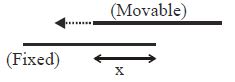
A parallel-plate capacitor consists of a fixed plate and a movable plate that is allowed to slide in the direction parallel to the plates. Let $x$ be the distance of overlap, as shown in the figure. The separation between the plates is fixed. Assume that the plates are electrically isolated, so that their charges $±Q$ are constant. Force on the movable plate is proportional to 
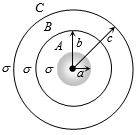
Three concentric metallic shells $A, B$ and $C$ of radii $a, b$ and $c (a < b < c)$ have surface charge densities $\sigma ,\, - \sigma $ and $\sigma $ respectively. then ${V_A}$ and ${V_B}$
The mass of a photo electron is
A body $A$ starts from rest with an acceleration $a_1$ . After $2\ seconds$ , another body $B$ starts from rest with an acceleration $a_2$ . If they travel equal distance in the $5th\ second$ , after the start of $A$ , then the ratio $a_1$ : $a_2$ is equal to
If no external voltage is applied across $ P-N$  junction, there would be
In a $PN$ junction photo cell, the value of photo-electromotive force produced by monochromatic light is proportional to
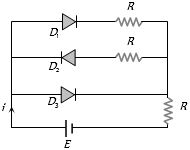
In the following circuit of $PN$ junction diodes $D_1, D_2$ and $D_3$ are ideal then $i$ is
The electrostatic potential due to an electric dipole at a distance ' $r$ ' varies as :
Two satellites $A$ and $B$ , having ratio of masses $3 : 1$ are in circular orbits of radius $r$ and $4r$ . Calculate the ratio of total mechanical energy of $A$ and $B$
The volume of an ideal gas is $1$ litre and its pressure is equal to $72cm$ of mercury column. The volume of gas is made $900\, cm^3$ by compressing it isothermally. The stress of the gas will be ...... $cm$ (mercury)