MCQ
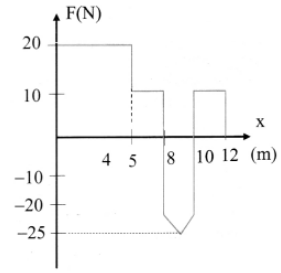
An object of mass 500 g, initially at rest, is acted upon by a variable force whose X-component varies with X in the manner shown. The velocities of the object at the points X = 8 m and X = 12 m, would have the respective values ofImage 
  • A
    18m/s and 20.6 m/s
  • B
    18 m/s and 24.4 m/s
  • C
    23 m/s and 24.4 m/s
  • D
    23 m/s and 20.6 m/s

Answer

Hint: From work-energy theorem
∆ K.E. = work = area under F-x graph
From x = 0 to x = 8m
$\frac{1}{2} mv ^2=(5 \times 20)+(3 \times 10)$
$\therefore \frac{1}{2} m v^2=100+30$
$\begin{array}{ll}\therefore & v ^2=520 \\ \therefore &
v =\sqrt{520}=22.8 \approx 23 m / s \end{array}$
Similarly, from $x=0$ to $x=12 m$
$\frac{1}{2} mv ^2=100+30-47.5+20$
$\therefore \quad \frac{1}{2} mv ^2=102.5$
$\therefore \quad v ^2=\frac{2 \times 102.5}{0.5}$
$\therefore \quad v =\sqrt{410} \approx 20.6 m / s$
23 m/s and 20.6 m/s

Need a full question paper?

Generate a complete, print-ready paper with questions like this in minutes — across 16+ boards, with answer keys.

Start Generating Free

Similar questions

The magnitude of scalar product of the vectors $\overrightarrow{ A }=2 \hat{ i }+5 \hat{ k }$ and $\vec{B}=3 \hat{ i }+4 \hat{ k }$ is
If the source is moving away from the observer, then the apparent frequency …………..
A magnetic dipole has magnetic length 10 cm and pole strength 100 Am. Its magnetic dipole moment is ………………. Am².
A body falls freely for 10s. Its average velocity during this journey $\left(\right.$ take $\left.g =10 ms^{-2}\right)$
A turn table which is rotating uniformly has a particle placed on it. As seen from the ground, the particle goes in a circle with speed 20 cm/s and acceleration $20 cm / s ^2$ The particle is now shifted to a new position where radius is half of the original value. The new values of speed and acceleration will be
The position of an object moving along x-axis is given by $x=a+b t^2$ where a = 8.5 m and b = 2.5 m and t is measured in second. If th object starts from t = 0, the velocity at t = 2 s is
Two masses ' $m_1$ ' and ' $m_2$ ' moving with velocities ' $v_1$ ' and ' $v_2$ ' in opposite directions collide elastically and after collision masses ' $m_1$ ' and ' $m_2$ ' move with velocity ' $v_2$ ' and ' $v_1$ ' respectively. The ratio $\left(\frac{v_2}{v_1}\right)$ is
Variation of acceleration due to gravity (g) with distance x from the centre of the Earth is best represented by (R → Radius of the Earth)
The graph of displacement v/s time is
Image
Its corresponding velocity-time graph will be
In case of $p-n$ junction diode, the width of depletion region is