MCQ
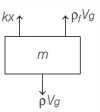
An object with uniform density $\rho$ is attached to a spring that is known to stretch linearly with applied force as shown below.When the spring object system is immersed in a liquid of density $\rho_1$ as shown in the above figure, the spring stretches by an amount $x_1\left(\rho > \rho_1\right)$. When the experiment is repeated in a liquid of density $\left(\rho_2 < \rho_1\right)$, the spring stretches by an amount $x_2$. Neglecting any buoyant force on the spring, the density of the object is
  • A
    $\rho=\frac{\rho_1 x_1-\rho_2 x_2}{x_1-x_2}$
  • $\rho=\frac{\rho_1 x_2-\rho_2 x_1}{x_2-x_1}$
  • C
    $\rho=\frac{\rho_1 x_2+\rho_2 x_1}{x_1+x_2}$
  • D
    $\rho=\frac{\rho_1 x_1+\rho_2 x_2}{x_1+x_2}$
Answer

Correct option: B.
$\rho=\frac{\rho_1 x_2-\rho_2 x_1}{x_2-x_1}$
b
(b)

For equilibrium of block hung from string, Spring force + Buoyant force $=$ Weight of block

So, we have

$k x_1+\rho_1 V g=\rho V g\quad \dots(i)$

$\text { and }$ $k x_2+\rho_2 V g=\rho V g \quad \dots(ii)$

Eliminating $k$, we get

$\rho=\frac{\rho_1 x_2-\rho_2 x_1}{x_2-x_1}$

Need a full question paper?

Generate a complete, print-ready paper with questions like this in minutes — across 16+ boards, with answer keys.

Start Generating Free

Similar questions

A drop of oil is placed on the surface of water. Which of the following statement is correct
Which of the following are true?
A person is standing on an open car moving with a constant velocity of $30\,\,m/s$  on a straight horizontal road. The man throws a ball in the vertically upward direction and it returns to the person after the car has moved $240\,\,m.$  The speed and the angle of projection
In the absence of external torque for a body revolving about any axis the quantity that remains constant is
If Planck’s constant $(h)$ and speed of light in vacuum $(c)$ are taken as two fundamental quantities, which one of the following can, in addition, be taken to express length, mass and time in terms of the three chosen fundamental quantities?
$A.$ Mass of electron $(m_e).$
$B.$ Universal gravitational constant $(G).$
$C.$ Charge of electron $(e).$
$D.$ Mass of proton $(m_p).$
From Kirchoff’s law the ratio of emissive power and absorption power of all bodies
$Assertion$ : A quick collision between two bodies is more violent than a slow collision; even when the initial and final velocities are identical.
$Reason$ : The momentum is greater in first case.
Measure of two quantities along with the precision of respective measuring instrument  $A = 2.5\,m{s^{ - 1}} \pm 0.5\,m{s^{ - 1}}$, $B = 0.10\,s \pm 0.01\,s$ The value of $AB$ will be
A solid sphere, of radius $R$ acquires a terminal velocity $\nu_1 $ when falling (due to gravity) through a viscous fluid having a coefficient of viscosity $\eta $. The sphere is broken into $27$ identical solid spheres. If each of these spheres acquires a terminal velocity, $\nu_2$, when falling through the same fluid, the ratio $(\nu_1/\nu_2)$ equals
An organ pipe, open at both ends, contains