MCQ
An observer moves towards a stationary source of sound with a velocity equal to one-fifth of the velocity of sound. The percentage change in the frequency will be $\dots \;$%
  • $20$
  • B
    $10$
  • C
    $5$
  • D
    $0$

Answer

Correct option: A.
$20$
a
$f_{0}=\left(\frac{v+v_{0}}{v}\right) f_{s}$

$f_{0}=\left(\frac{v+\frac{v}{5}}{v}\right) f_{s}$

$f_{0}=\frac{6}{5} f_{s}$

$\%$ change $=\frac{f_{0}-f_{s}}{f_{s}} \times 100$

$=\frac{1}{5} \times 100=20 \%$

Need a full question paper?

Generate a complete, print-ready paper with questions like this in minutes — across 16+ boards, with answer keys.
Start Generating Free

Similar questions

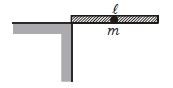
The left end of a massless stick with length $l$ is placed on the corner of a table, as shown in Fig. A point mass $m$ is attached to the center of the stick, which is initially held horizontal. It is then released. Immediately afterward, what normal force does the table exert on the stick?
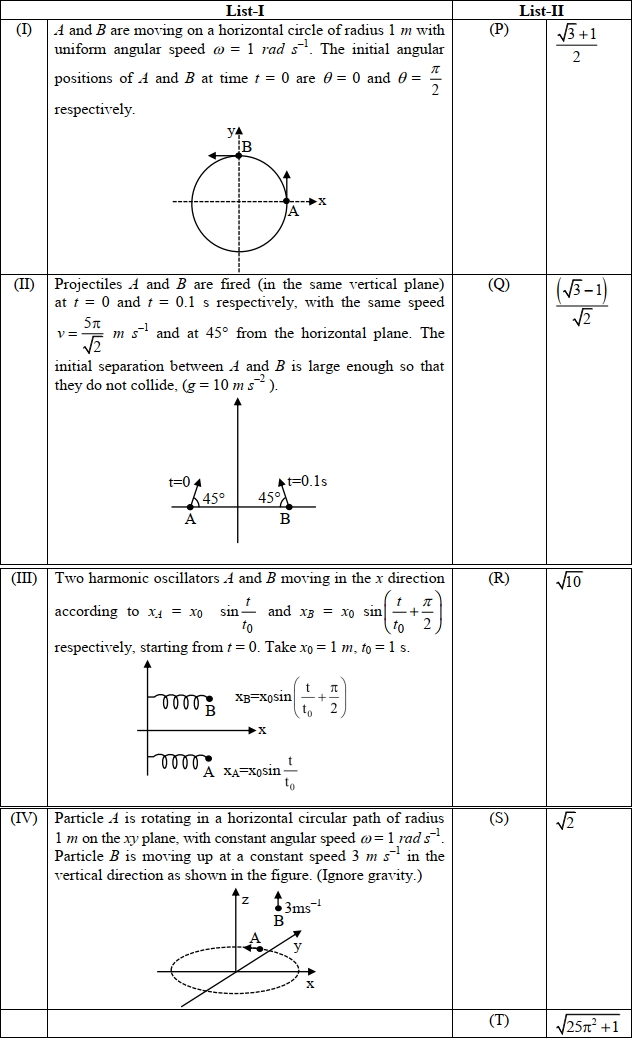
$List I$ describes four systems, each with two particles $A$ and $B$ in relative motion as shown in figure. $List II$ gives possible magnitudes of then relative velocities (in $ms ^{-1}$ ) at time $t=\frac{\pi}{3} s$.

Which one of the following options is correct?
A star of mass $M$ and radius $R$ is made up of gases. The average gravitational pressure compressing the star due to gravitational pull of the gases making up the star depends on $R$ as
If the collision frequency of hydrogen molecules in a closed chamber at $27^{\circ} \mathrm{C}$ is $\mathrm{Z}$, then the collision frequency of the same system at $127^{\circ} \mathrm{C}$ is :
$A$ and $B$ are arguing about uniform acceleration. $A$ states that acceleration means "the longer you go." $B$ states that acceleration means "the further you go." Who is right?
A body projected vertically upwards with a velocity $u$ returns to the starting point in $4 \,seconds$. If $g = 10m/sec^2$, the value of $u$ is.........$m/sec$
A body of mass $2\, kg $ moving with a velocity of $3 \,m/sec$ collides head on with a body of mass $1\, kg$ moving in opposite direction with a velocity of $4 \,m/sec$. After collision, two bodies stick together and move with a common velocity which in m/sec is equal to
Consider two observers moving with respect to each other at a speed $v$ along a straight line. They observe a block of mass $m$ moving a distance $l$ on a rough surface. The following quantities will be same as observed by the two observers.
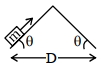
An object of mass $'m'$ is being moved with a constant velocity under the action of an applied force of $2\, {N}$ along a frictionless surface with following surface profile.

The correct applied force vs distance graph will be:
A block of mass M is hanging over a smooth and light pulley through a light string. T he other end of the string is pulled by a constant force F. The kinetic energy of the block increases by 20J in 1s.