MCQ
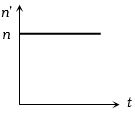
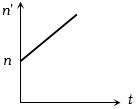
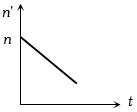
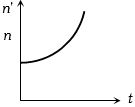
An observer starts moving with uniform acceleration $a$ toward a stationary sound source emitting a whistle of frequency $n.$ As the observer approaches source, the apparent frequency, heard by the observer varies with time as
  • A


  • C

  • D

Answer

Correct option: B.

b
(b) For observer approaching a stationary source

$n' = \frac{{v + {v_0}}}{v}.n$ and given ${v_0} = at$==>$n' = \left( {\frac{{an}}{v}} \right)\;t + n$

this is the equation of straight line with positive intercept $n$ and positive slope $\left( {\frac{n}{v}} \right)$.

Need a full question paper?

Generate a complete, print-ready paper with questions like this in minutes — across 16+ boards, with answer keys.
Start Generating Free

Similar questions

The spectral energy distribution of star is maximum at twice temperature as that of sun. The total energy radiated by star is
A particle has a velocity u towards east at t = 0. Its acceleration is towards west and is constant. Let xA and xB be the magnitude of displacements in the first 10 seconds and the next 10 seconds:
A body is moving unidirectionally under the influence of a constant power source. Its displacement in time $t$ is proportional to :
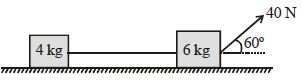
The tension in the string which connected the blocks as shown in the following figure  ............ $ N$
A body of mass $m$ is moving in a circle of radius $r$ with a constant speed $v. $ The force on the body is $\frac{{m{v^2}}}{r}$ and is directed towards the centre. What is the work done by this force in moving the body over half the circumference of the circle
The resultant of $\overrightarrow A + \overrightarrow B $ is ${\overrightarrow R _1}.$ On reversing the vector $\overrightarrow {B,} $ the resultant becomes ${\overrightarrow R _2}.$ What is the value of $R_1^2 + R_2^2$
A rocket of initial mass $6000\, kg$ ejects gases at a constant rate of $16\, kgs^{-1}$ with constant relative speed of $11\, kms^{-1}$ in gravity free space. What is the acceleration of the rocket $1\, min$. after the blast ............ $ m/sec^2$
If work $W$ is done in blowing a bubble of radius $R$ from a soap solution, then the work done in blowing a bubble of radius $2R$ from the same solution is
Let V and E be the gravitational potential and gravitational field at a distance r from the centre of a uniform spherical shell. Consider the following two statements:
  1. The plot of V against r is discontinuous.
  2. The plot of E against r is discontinuous.
  1. Both A and B are correct.
  2. A is correct but B is wrong.
  3. B is correct but A is wrong.
  4. Both A and B are wrong.
A particle which is experiencing a force, given by $\vec F = 3\vec i -12\vec j$, undergoes a displacement of $\vec d = 4\vec i$ . If the particle had a kinetic energy of $3\, J$ at the beginning of the displacement, what is its kinetic energy at the end of the displacement?