MCQ
An open pipe of length $33\, cm$ resonates to a frequency of $1000\,Hz$. The mode of   vibration is: (velocity of sound $= 330\, m/s$)
  • A
    Fundamental
  • The $2^{nd}$ harmonic
  • C
    The $3^{rd}$ harmonic
  • D
    The $4^{th}$ harmonic

Answer

Correct option: B.
The $2^{nd}$ harmonic
b
For open organ pipe

$f = \frac{{nv}}{{2l}} \Rightarrow 1000 = \frac{{n \times 330}}{{2 \times 33}} \times 100$

${2=n} $

$f = \frac{{2v}}{{2l}} \to {2^{nd}}$ harmonic 

Need a full question paper?

Generate a complete, print-ready paper with questions like this in minutes — across 16+ boards, with answer keys.
Start Generating Free

Similar questions

The velocity of projection of a body is increased by $2 \% .$ Other factors remaining unchanged, what will be the percentage change in the maximum height attained ? (in $\%$)
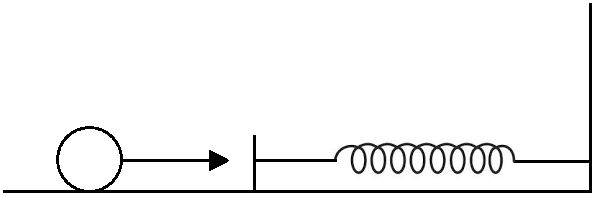
A mass of $0.5\ kg$ moving with a speed of $1.5\ ms^{-1}$ on a horizontal smooth surface, collides with a nearly weightless spring of spring constant $k = 50\ N/ m^{-1}$

The maximum compression of the spring would be:
Variation of atmospheric pressure, with height from earth is ................
Let $A_n$ be the area enclosed by the $n^{th}$ orbit in a hydrogen atom. The graph of ln $\Big(\frac{\text{A}_\text{n}}{\text{A}_1}\Big)$ against in $(n):$
A uniform sphere of mass $500\; g$ rolls without slipping on a plane horizontal surface with its centre moving at a speed of $5.00\; \mathrm{cm} / \mathrm{s}$. Its kinetic energy is
In planetary motion the areal velocity of position vector of a planet depends on angular velocity $(\omega )$ and the distance of the planet from sun $(r)$. If so the correct relation for areal velocity is
A boat covers certain distance between two spots in a river taking $t_1$ hrs going downstream and $t_2$ hrs going upstream. What time will be taken by boat to cover same distance in still water?
A small steel ball of radius $r$ is allowed to fall under gravity through a column of a viscous liquid of coefficient of viscosity $\eta $. After some time the velocity of the ball attains a constant value known as terminal velocity ${v_T}$. The terminal velocity depends on $(i)$ the mass of the ball $m$, $(ii)$ $\eta $, $(iii)$ $r$ and $(iv)$ acceleration due to gravity $g$. Which of the following relations is dimensionally correct
The surface area of a solid cylinder of radius $2.0\ cm$ and height $A \ cm$ is equal to $1.5 \times 10^4(mm)^2$. Here, $A$ refers to:
Liquids have: