An open pipe of length $33\,cm$ resonates to a frequency of $1000\,Hz$ . The mode of vibration is: (velocity of sound $= 330\,m/s$ )
Medium


Download our appand get started for free
Experience the future of education. Simply download our apps or reach out to us for more information. Let's shape the future of learning together!No signup needed.*
Similar Questions
- 1A travelling wave is partly reflected and partly transmitted from a rigid boundary. Let $a_i, a_r$ and $a_t$ be the amplitude of incident wave, reflected wave and transmitted wave and $I_i, I_r$ and $I_t$ be the corresponding intensities. Then choose the correct alternativesView Solution
- 2A train, standing in a station yard, blows a whistle of frequency $400 \,\,Hz$ in still air. The wind starts blowing in the direction from the yard to the station with a speed of $10\,\,m/s.$ Given that the speed of sound in still air is $340\,\,m/s.$ Mark the INCORRECT statement :View Solution
- 3A transverse wave is represented by $y=2 \sin$ $(\omega t - kx ) cm$. The value of wavelength (in $cm$ ) for which the wave velocity becomes equal to the maximum particle velocity, will be.View Solution
- 4The number of possible natural oscillations of air column in a pipe closed at one end of length $85 \,\,cm$ whose frequencies lie below $1250\,\, Hz$ are (Velocity of sound $= 340 \,\,m s^{-1}$)View Solution
- 5$A$ is singing a note and at the same time $B$ is singing a note with exactly one-eighth the frequency of the note of $A$. The energies of two sounds are equal, the amplitude of the note of $B$ isView Solution
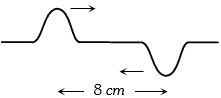
- 6Two pulses in a stretched string whose centres are initially $8 cm$ apart are moving towards each other as shown in the figure. The speed of each pulse is $2 cm/s$. After $2$ seconds, the total energy of the pulses will beView Solution
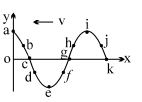
- 7The figure represents the instantaneous picture of a longitudinal harmonic wave travelling along the negative $x$-axis. Identify the correct statement $(s)$ related to the movement of the points shown in the figure. The points moving opposite to the direction of propagation areView Solution
- 8An open pipe is in resonance in its $2^{nd}$ harmonic with tuning fork of frequency ${f_1}$. Now it is closed at one end. If the frequency of the tuning fork is increased slowly from ${f_1}$ then again a resonance is obtained with a frequency ${f_2}$. If in this case the pipe vibrates ${n^{th}}$ harmonics thenView Solution
- 9On sounding tuning fork $A$ with another tuning fork $B$ of frequency $384 Hz, 6$ beats are produced per second. After loading the prongs of $A$ with some wax and then sounding it again with $B, 4$ beats are produced per second. What is the frequency of the tuning fork $A$ .... $Hz$View Solution
- 10View SolutionCoherent sources are characterized by the same