Question
An optical instrument used for angular magnification has a $25D$ objective and a $20D$ eyepiece. The tube length is $25\ cm$ when the eye is least strained.
  1. Whether it is a microscope or a telescope?
  2. What is the angular magnification produced?
Answer

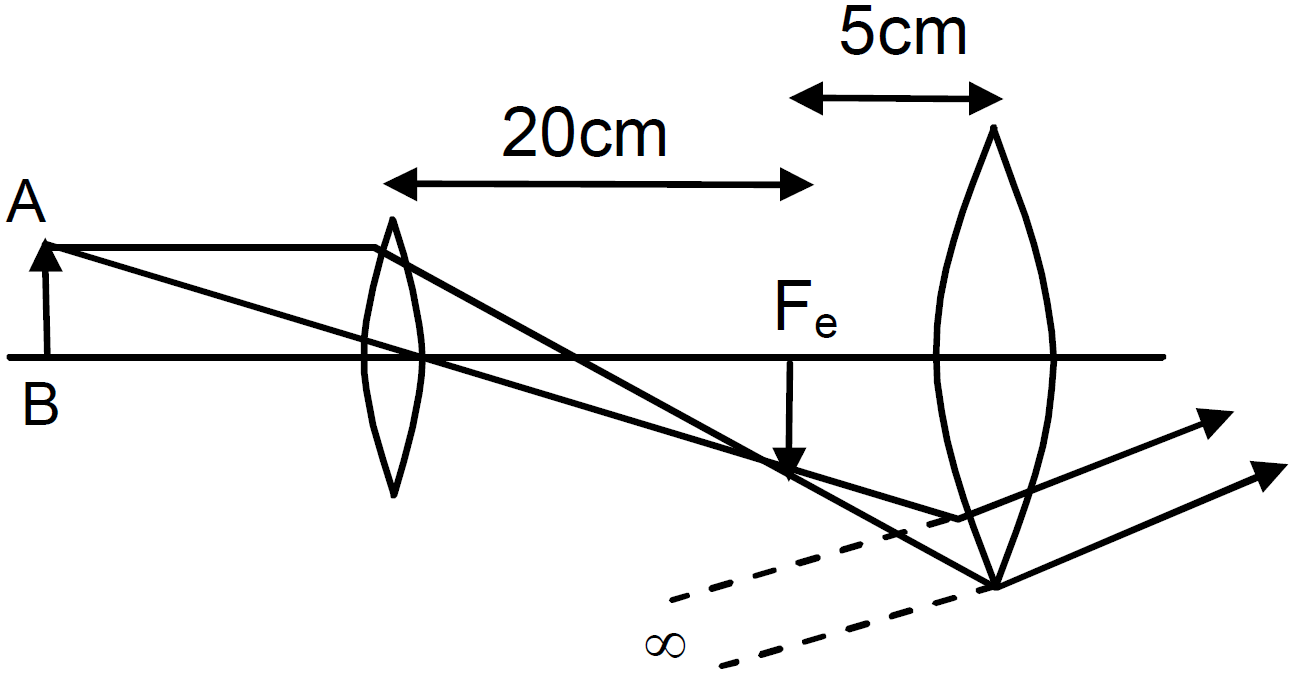
The optical instrument has $\text{f}_0=\frac{1}{25\text{D}}=0.04\text{m}=4\text{cm}$
$\text{f}_\text{e}=\frac{1}{20\text{D}}=0.05\text{m}=5\text{cm}$
tube length $= 25\ cm\ ($normal adjustment$)$
  1. The instrument must be a microscope as $f_0< f_e$
  2. Since the final image is formed at infinity, the image produced by the objective should lie on the focal plane of the eye piece.
So, image distance for objective $= v_0 = 25 – 5 = 20\ cm$
Now, using lens formula.
$\frac{1}{\text{v}_0}-\frac{1}{\text{u}_0}=\frac{1}{\text{f}_0}$
$\Rightarrow\frac{1}{\text{u}_0}=\frac{1}{\text{v}_0}-\frac{1}{\text{f}_0}=\frac{1}{20}-\frac{1}{4}$
$=\frac{-4}{20}=\frac{-1}{5}$
$\Rightarrow\text{u}_0=-5\text{cm}$
So, angular magnification $\text{m}=-\frac{\text{v}_0}{\text{u}_0}\times\frac{\text{D}}{\text{f}_\text{e}}\ [$Taking $D = 25\ cm]$
$=-\frac{20}{-5}\times\frac{25}{5}=20$

Need a full question paper?

Generate a complete, print-ready paper with questions like this in minutes — across 16+ boards, with answer keys.

Start Generating Free

Similar questions

Figure shows a square loop ABCD with edgelength a. The resistance of the wire ABC is r and that of ADC is 2r. Find the magnetic field B at the centre of the loop assuming uniform wires.
An ornament weighing $36g$ in air, weighs only $34g$ in water. Assuming that some copper is mixed with gold to prepare the ornament, find the amount of copper in it. Specific gravity of gold is $19.3$ and that of copper is $8.9$.
Find the speed at which the kinetic enei:gy of a particle will differ by 1% from its nonrelativistic value $\frac{1}{2}\text{m}_0\text{v}^2$
A block of mass M is kept on a rough horizontal surface. The coefficient of static friction between the block and the surface is $\mu.$ The block is to be pulled by applying a force to it. What minimum force is needed to slide the block? In which direction should this force act?
A $12pF$ capacitor is connected to a $50V$ battery. How much electrostatic energy is stored in the capacitor?
Three immiscible liquids of densities $d_1 > d_2 > d_3$ and refractive indices $\mu _1 > \mu _2 > \mu _3$ are put in a beaker. The height of each liquid column is $\frac{\text{h}}{3}$. A dot is made at the bottom of the beaker. For near normal vision, find the apparent depth of the dot.
Can the instantaneous power output of an ac source ever be negative? Can the average power output be negative?
A heavy but uniform rope of length L is suspended from a ceiling.
  1. Write the velocity of a transverse wave travelling on the string as a function of the distance from the lower.
  2. If the rope is given a sudden sideways jerk at the bottom, how long will it take for the pulse to reach the ceiling?
  3. A particle is dropped from the ceiling at the instant the bottom end is given the jerk. Where will the particle meet the pulse ?
A concave mirror forms an image of $20\ cm$ high object on a screen placed $5.0m$ away from the mirror. The height of the image is $50\ cm$. Find the focal length of the mirror and the distance between the mirror and the object.
The $2.0\Omega$ resistor shown in the figure is dipped into a calorimeter containing water. The heat capacity of the calorimeter together with water is $2000JK-^1$.
  1. If the circuit is active for $15$ minutes, what would be the rise in the temperature of the water?
  2. Suppose the $6.0\Omega$ resistor gets burnt. What would be the rise in the temperature of the water in the next $15$ minutes?