Question
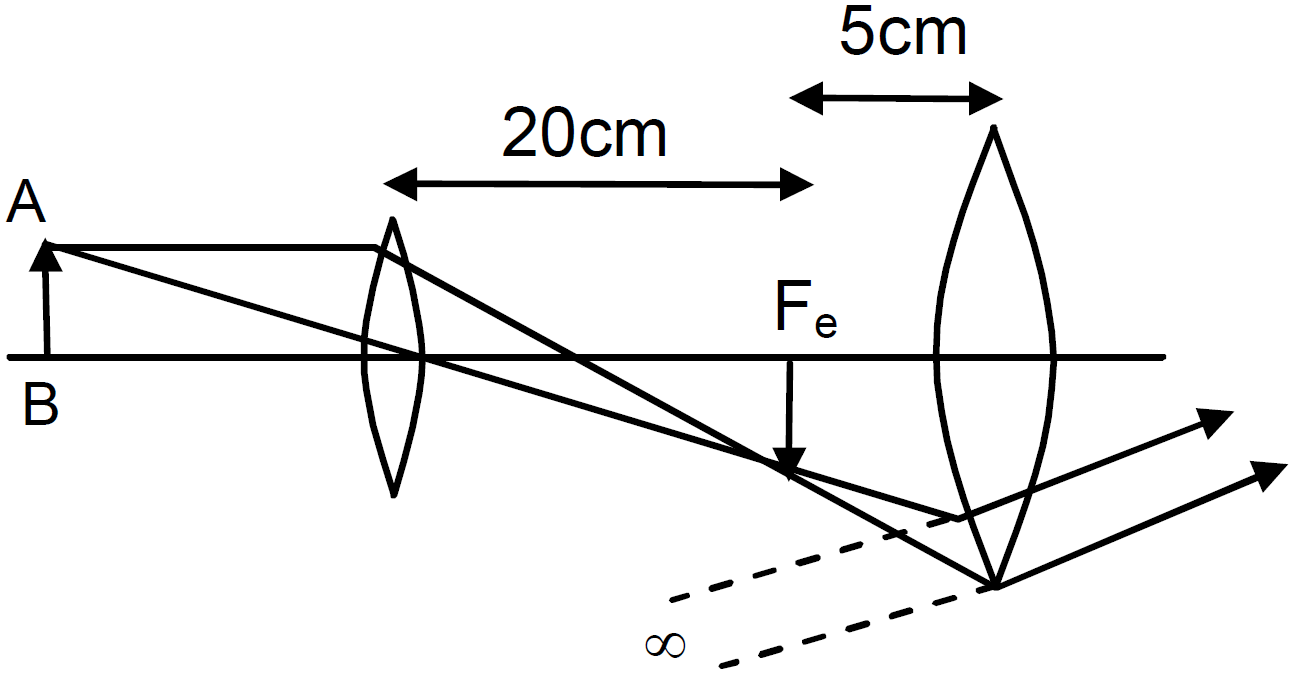
An optical instrument used for angular magnification has a 25D objective and a 20D eyepiece. The tube length is 25cm when the eye is least strained.
  1. Whether it is a microscope or a telescope?
  2. What is the angular magnification produced?

Answer

The optical instrument has

$\text{f}_0=\frac{1}{25\text{D}}=0.04\text{m}=4\text{cm}$

$\text{f}_\text{e}=\frac{1}{20\text{D}}=0.05\text{m}=5\text{cm}$

tube length = 25cm (normal adjustment)

  1. The instrument must be a microscope as f0 < fe
  2. Since the final image is formed at infinity, the image produced by the objective should lie on the focal plane of the eye piece.

So, image distance for objective = v0 = 25 – 5 = 20cm

Now, using lens formula.

$\frac{1}{\text{v}_0}-\frac{1}{\text{u}_0}=\frac{1}{\text{f}_0}$

$\Rightarrow\frac{1}{\text{u}_0}=\frac{1}{\text{v}_0}-\frac{1}{\text{f}_0}=\frac{1}{20}-\frac{1}{4}$

$=\frac{-4}{20}=\frac{-1}{5}\Rightarrow\text{u}_0=-5\text{cm}$

So, angular magnification $\text{m}=-\frac{\text{v}_0}{\text{u}_0}\times\frac{\text{D}}{\text{f}_\text{e}}$[Taking D = 25cm]

$=-\frac{20}{-5}\times\frac{25}{5}=20$
Need a full question paper?

Generate a complete, print-ready paper with questions like this in minutes — across 16+ boards, with answer keys.

Start Generating Free

Similar questions

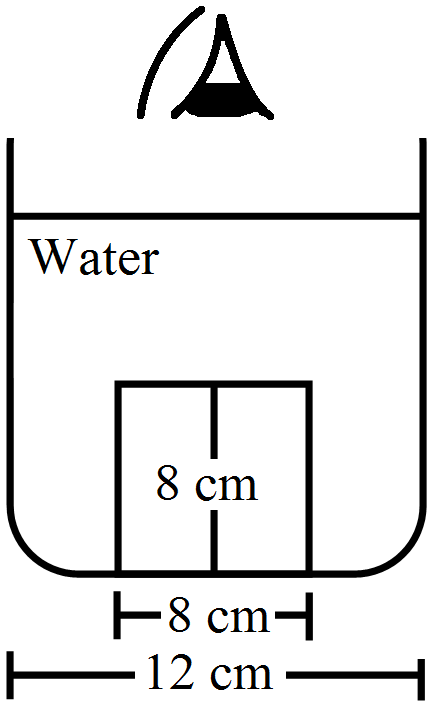
A cylindrical vessel of diameter 12cm contains $800\pi\text{cm}^3$ of water. A cylindrical glass piece of diameter 8.0 cm and height 8.0cm is placed in the vessel. If the bottom of the vessel under the glass piece is seen by the paraxial rays, locate its image. The index of refraction of glass is 1.50 and that of water is 1.33.

Draw a phasor diagram for series LCR circuit joined with ac voltage source and obtain an expression for impedance of the circuit.
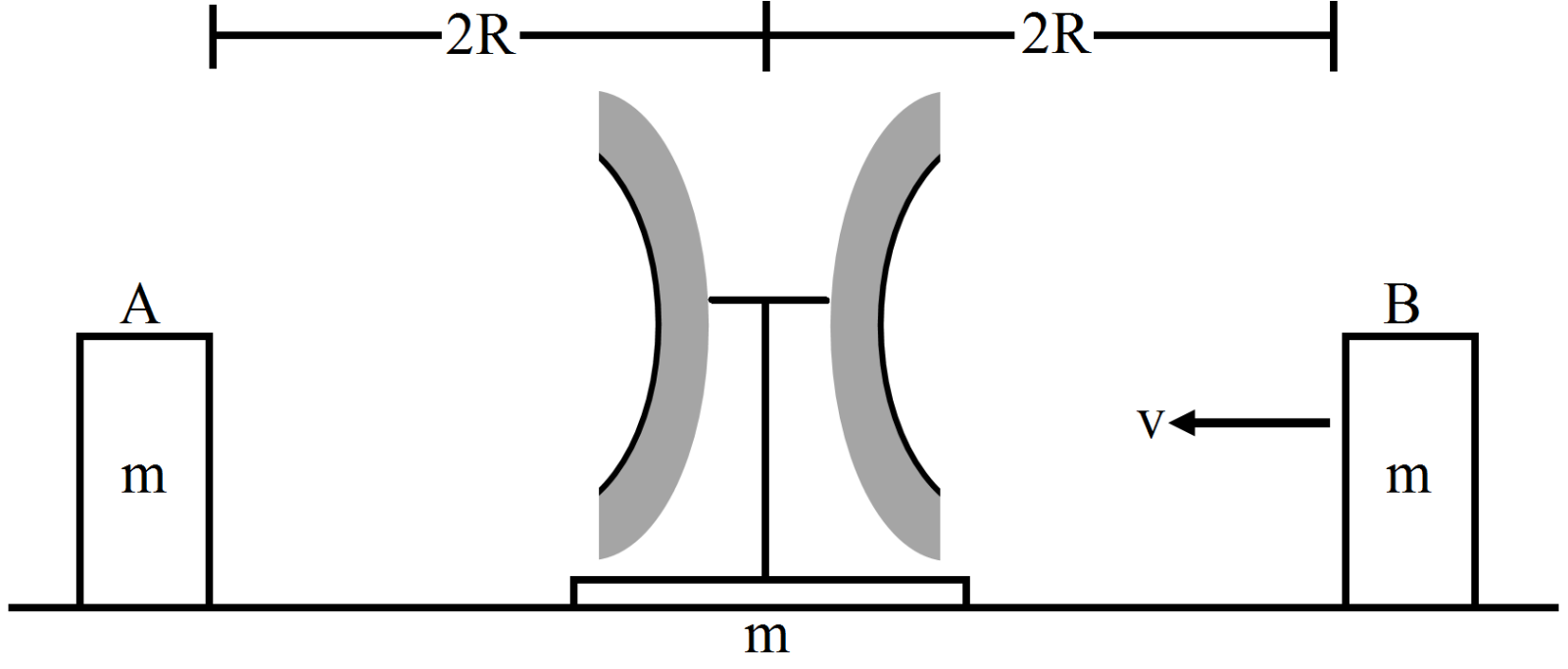
Two concave mirrors of equal radii of curvature R are fixed on a stand facing opposite directions. The whole system has a mass m and is kept on a frictionless horizontal table.

Two blocks A and B, each of mass m, are placed on the two sides of the stand. At t = 0, the separation between A and the mirrors is 2 R and also the separation between B and the mirrors is 2 R. The block B moves towards the mirror at a speed v. All collisions which take place are elastic. Taking the original position of the mirrors-stand system to be x = 0 and X-axis along AB, find the position of the images of A and B at t =
  1. $\frac{\text{R}}{\text{v}}$

  2. $\frac{3\text{R}}{\text{v}}$

  3. $\frac{5\text{R}}{\text{v}}$

  1. Compare the individual dipole moment and the specimen dipole moment for H2O molecule and O2 molecule when placed in:
  1. Absence of external electric field.
  2. Presence of external eclectic field. Justify your answer.
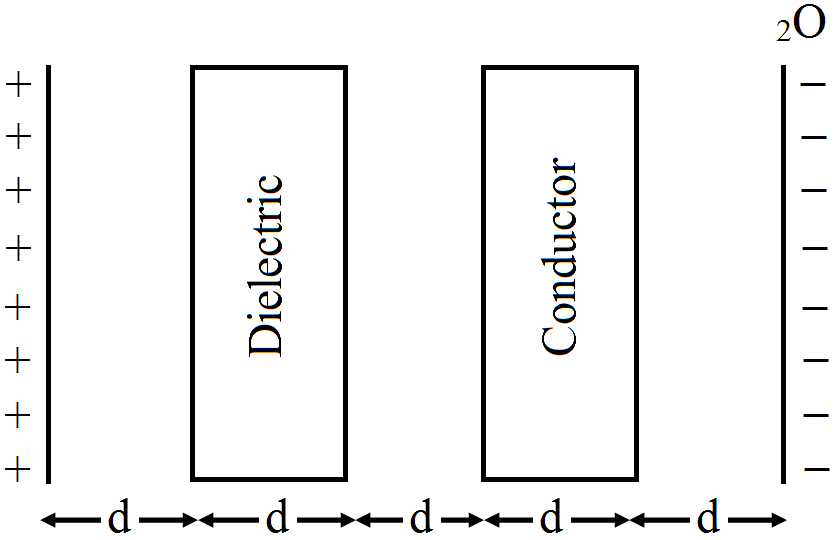
  1. Given two parallel conducting plates of area A and charge densities $+\sigma$ and $-\sigma.$ A dielectric slab of constant K and a conducting slab of thickness d each are inserted in between them as shown.

  1. Find the potential difference between the plates.
  2. Plot E versus x graph, taking x = 0 at positive plate and x = 5d at negative plate.
A block of mass M is kept on a rough horizontal surface. The coefficient of static friction between the block and the surface is $\mu.$ The block is to be pulled by applying a force to it. What minimum force is needed to slide the block? In which direction should this force act?
A particle of charge 2.0 × 10⁻⁸C and mass 2.0 × 10⁻¹⁰g is projected with a speed of 2.0 × 10³m/s-1in a region with a uniform magnetic field of 0.10T. The velocity is perpendicular to the field. Find the radius of the circle formed by the particle and also the time period.
A circular loop carrying a current i is made of a wire of length L. A uniform magnetic field B exists parallel to the plane of the loop.
  1. Find the torque on the loop.
  2. If the same length of the wire is used to form a square loop, what would be the torque? Which is larger?
Obtain expressions for average current and root mean square current for a complete cycle in ac circuit.###Obtain root mean square value of current for one complete cycle of current $I=I_0 \sin \omega t$. Draw graph between instantaneous value and root mean square value of current for two complete cycles.###Obtain rms value of alternating current for a complete cycle of sinusoidal current.\[I = I _0 \sin \omega t .\]
Keeping the source frequency equal to the resonating frequency of the series LCR circuit, if the three elements, L, C and R are arranged in parallel, show that the total current in the parallel LCR circuit is minimum at this frequency. Obtain the current rms value in each branch of the circuit for the elements and source specified in Exercise 7.11 for this frequency.
The internal energy of a gas is given by U = 1.5PV. It expands from 100cm3 to 200cm3 against a constant pressure of 1.0 x 10⁵Pa. Calculate the heat absorbed by the gas in the process.