Question
An optically active compound (a) Rotates the plane polarised light(b) Changing the direction of polarised light (c) Do not allow plane polarised light to pass through(d) None of the above


Answer

(a) Rotates the plane polarised light

Need a full question paper?

Generate a complete, print-ready paper with questions like this in minutes — across 16+ boards, with answer keys.
Start Generating Free

Similar questions

The solar constant on the surface of the earth is $S$. What will be its value on the surface of another planet which is about $5.3 A . U$. away from sun
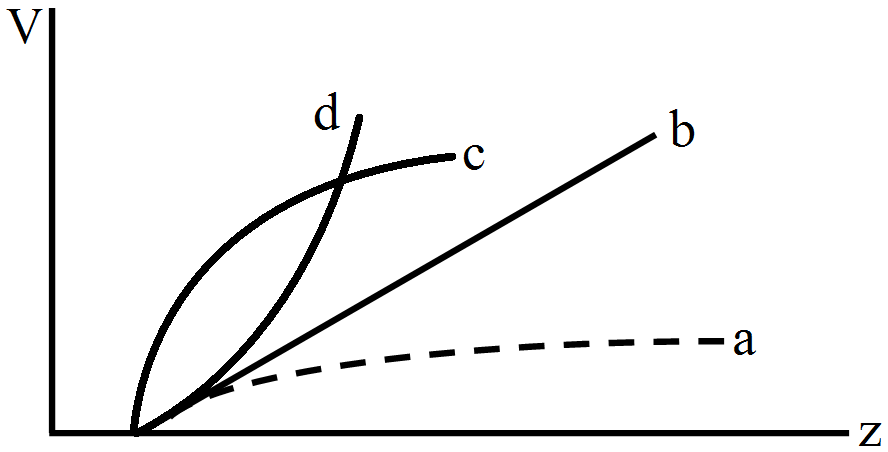
The figure shows the intensity$-$wavelength relations of $X-$rays coming from two different Coolidge tubes. The solid curve represents the relation for the tube $A $ in which the potential difference between the target and the filament is $V_A$ and the atomic number of the target material is $Z_A.$ These quantities are $V_B$ and $Z_B$ for the other tube. Then$:$
Electric current produced by a moving straight wire in a magnetic field is?
A movie projector forms an image $3.5m$ long of an object $35 \ mm$. Supposing there is negligible absorption of light by aperture then illuminance on slide and screen will be in the ratio of
Which of the following of a radioactive material is a measure of its instability?
Assertion : Electron capture occurs more often than positron emission in heavy elements.
Reason    : Heavy elements exhibit radioactivity.(a) If both assertion and reason are true and the reason is the correct explanation of the assertion.(b) If both assertion and reason are true but reason is not the correct explanation of the assertion.(c) If assertion is true but reason is false.(d) If the assertion and reason both are false.


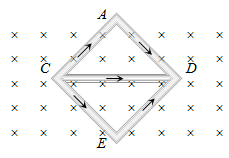
Same current $i = 2A$ is flowing in a wire frame as shown in figure. The frame is a combination of two equilateral triangles $ACD$ and $CDE$ of side $1m.$ It is placed in uniform magnetic field $B = 4T$ acting perpendicular to the plane of frame. The magnitude of magnetic force acting on the frame is
Who amongst the following used corpuscular theory to explain the nature of light?
How many spectral lines are there in the hydrogen spectrum?
The dispersive power is maximum for the material(a) Flint glass(b) Crown glass(c) Mixture of both(d) None of the above