Question
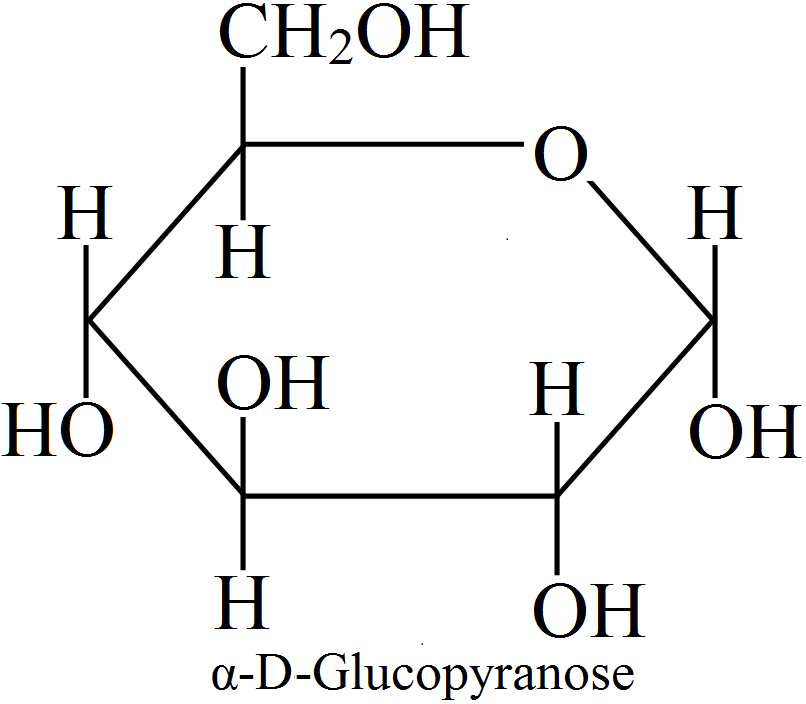
An optically active compound having molecular formula C6H12O6 is found in two isomeric forms (A) and (B) in nature. When (A) and (B) are dissolved in water, they show the following equilibrium.
$(\text{A})\ \ \ \ \rightleftharpoons\ \ \ \ \text{Equilibrium mixture}\ \ \ \ \rightleftharpoons\ \ \ \ \text{(B)}\\ [\alpha]_{\text{D}}=111^\circ\ \ \ \ \ \ \ \ \ \ \ \ \ \ 52.2^\circ\ \ \ \ \ \ \ \ \ \ \ \ \ \ \ \ \ \ \ \ \ \ \ \ \ \ 19.2^\circ$
  1. What are such isomers called?
  2. Can they be called enantiomers? Justify your answer.
  3. Draw the cyclic structure of isomer (A).
Answer

  1. Anomers.
  2. Since these anomers are not mirror images of each other so they cannot be called as enantiomers.
  3.  

Need a full question paper?

Generate a complete, print-ready paper with questions like this in minutes — across 16+ boards, with answer keys.

Start Generating Free

Similar questions

Primary alkyl halide C4H9Br(A) reacted with alcoholic KOH to give compound (B). Compound (B) is reacted with HBr to give (C) which is an isomer of (A). When (A) is reacted with sodium metal, it gives compound (D), C8H18which is different from the compound formed when n-butyl bromide is reacted with sodium. Give the structural formula of (A) and write the equations for all the reactions.
Short note on: Maltose
Give reasons:
  1. The a-hydrogen atoms of aldehydes and ketones are acidic in nature.
  2. Propanone is less reactive than ethanol toward addition of HCN.
  3. Benzoic acid does not give Friedal-Crafts reaction.
Answer the following questions:
Explain why the dipole moment of chlorobenzene is lower than that of cyclohexyl chloride.
Indicate the steps in the preparation of:
K2Cr2O7 from chromite ore.
How would you account for the following?
  1. Transition metals exhibit variable oxidation states.
  2. Zr(z=40) and Hf (Z=72) have almost identical redii.
  3. Transition metals and their compounds act as catalyst.
Explain solubility of gas in a liquid solvent.
Give equations required for the following changes:
(i) Ethanal to methanamine
(ii) Ethanocyl chloride to methanamine
(iii) Ethanoic acid to propan-1-amine.
  1. Draw the structures of all isomeric alcohols of molecular formula C5H12O and give their IUPAC names.
  2. Classify the isomers of alcohols in question 11.3 (i) as primary, secondary and tertiary alcohols.
The electrical resistance of a column of 0.05 M KOH solution of diameter 1 cm and length 45·5 cm is 4.55 $\times$ 103 ohm. Calculate its molar conductivity.