Question
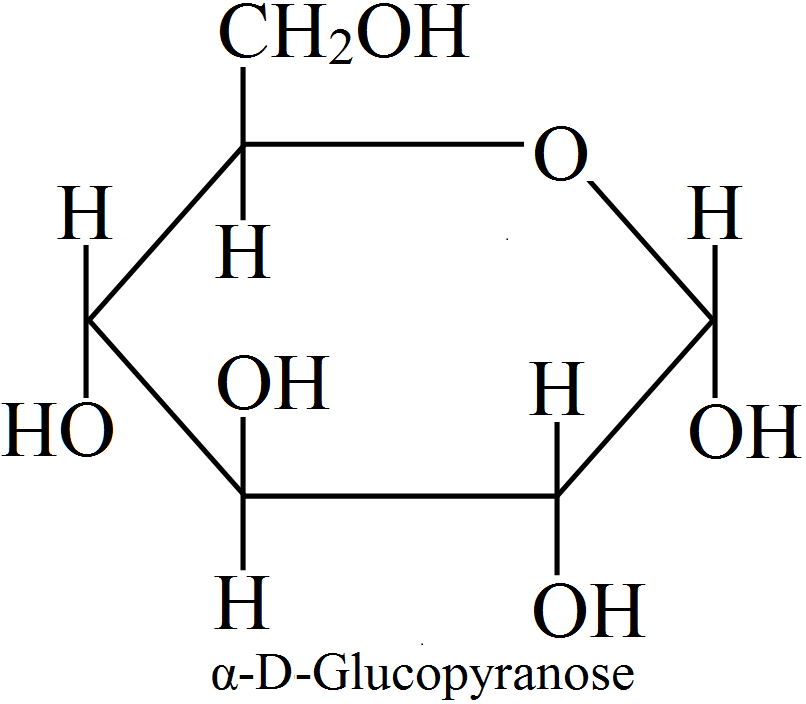
An optically active compound having molecular formula C6H12O6 is found in two isomeric forms (A) and (B) in nature. When (A) and (B) are dissolved in water, they show the following equilibrium.
$(\text{A})\ \ \ \ \rightleftharpoons\ \ \ \ \text{Equilibrium mixture}\ \ \ \ \rightleftharpoons\ \ \ \ \text{(B)}\\ [\alpha]_{\text{D}}=111^\circ\ \ \ \ \ \ \ \ \ \ \ \ \ \ 52.2^\circ\ \ \ \ \ \ \ \ \ \ \ \ \ \ \ \ \ \ \ \ \ \ \ \ \ \ 19.2^\circ$
  1. What are such isomers called?
  2. Can they be called enantiomers? Justify your answer.
  3. Draw the cyclic structure of isomer (A).
Answer

  1. Anomers.
  2. Since these anomers are not mirror images of each other so they cannot be called as enantiomers.
  3.  

Need a full question paper?

Generate a complete, print-ready paper with questions like this in minutes — across 16+ boards, with answer keys.

Start Generating Free

Similar questions

  1. The cell in which the following reaction occurs:
$2 Fe^{3+} (aq) + 2 I^- (aq) \longrightarrow 2 Fe^{2+}(aq) + I_2 (s)$

has $\text{E}^0_{\text{cell}}$ = 0·236 V at 298 K. Calculate the standard Gibbs energy of the cell reaction. (Given : $1 F = 96,500 C mol^{-1}$)
  1. How many electrons flow through a metallic wire if a current of 0·5 A is passed for 2 hours? (Given : $1 F = 96,500 C mol^{-1}$)
How would you account for the following:
Transition metals sometimes exhibit very low oxidation state such as $+1$ and $0$.
Calculate the standard free energy change for the following reaction at $25°C$.
$\text{Au(s) + Ca}^{2+}(1\text{M})\xrightarrow{ \ \ \ \ \ \ \ }\text{Au}^{3+}(1\text{m) + Ca(s)}$
$\text{E}^{\circ}_{\text{Au}^{3+}/\text{Au}}=+1.50\text{V},=\text{E}^{\circ}_{\text{Ca}^{2+}/\text{Ca}}-2.87\text{V}$
Predict whether the reaction will be spontaneous or not at $25°C$. Which of the above two half cells will act as an oxidising agent and which one will be a reducing agent?
What is meant by crystal field splitting energy? On the basis of crystal field theory, write the electronic configuration of $\mathrm{d}^4$ in terms of $t_{2 g}$ and $e_g$ in an octahedral field when
i. $\Delta_0>\mathrm{P}$
ii. $\Delta_0$
(a) Which is the salt of Mn which is isostructural to $KClO _4$ ?
(b) Explain the structure and magnetic properties of manganese and permanganate ions.
  1. Name the sweetening agent used in the preparation of sweets for a diabetic patient.
  2. What are antibiotics? Give an example.
  3. Give two examples of macromolecules that are chosen as drug targets.
Calculate e.m.f of the following cell at 298 K :
$2 \mathrm{Cr}(\mathrm{~s})+3 \mathrm{Fe}^{2+}(0.1 \mathrm{M}) \rightarrow 2 \mathrm{Cr}^{3+}(0.01 \mathrm{M})+3 \mathrm{Fe}(\mathrm{~s})$
$\text { Given: } \mathrm{E}^{\circ}\left(\mathrm{Cr}^{3+} \mid \mathrm{Cr}\right)=-0.74 \mathrm{VE}^{\circ}\left(\mathrm{Fe}^{2+} \mid \mathrm{Fe}\right)=-0.44 \mathrm{~V}$
Complete the following chemical reaction equations:
$\text{Cr}_2\text{O}^{2-}_7(\text{aq})+\text{Fe}^{2+}(\text{aq})+\text{H}^+(\text{aq})\xrightarrow{\ \ \ \ \ \ \ \ \ }$
Calculate the temperature at which a solution containing $54$ g of glucose, $C_6H_{12}O_6,$ in $250$ g of water will freeze. $[K_f$ for water $= 1.86\ K\ kg\ mol^{–1}].$
A colourless inorganic salt A decomposes at about $250^\circ C$ to give only two products $B$ and $C$ leaving no residue. The oxide $C$ is a liquid at room temperature and is neutral to litmus paper while $B$ is neutral oxide. White phosphorus burns in excess of $B$ to produce strong dehydrating agent. Give balanced equations for above processes.