MCQ
An optically active compound
  • Rotates the plane polarised light
  • B
    Changing the direction of polarised light
  • C
    Do not allow plane polarised light to pass through
  • D
    None of the above

Answer

Correct option: A.
Rotates the plane polarised light
a
(a)When the plane-polarised light passes through certain substance, the plane of polarisation of the light is rotated about the direction of propagation of light through a certain angle.

Need a full question paper?

Generate a complete, print-ready paper with questions like this in minutes — across 16+ boards, with answer keys.

Start Generating Free

Similar questions

The values of a number of quantities are used in a mathematical formula. The quantity that should be most precise and accurate in measurement is the one
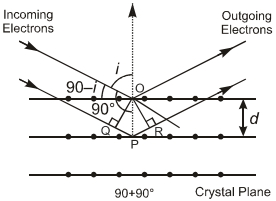
Wave property of electrons implies that they will show diffraction effects. Davisson and Germer demonstrated this by diffracting electrons from crystals. The law governing the diffraction from a crystal is obtained by requiring that electron waves reflected from the planes of atoms in a crystal interfere constructively (see figure).

Electrons accelerated by potential $V$ are diffracted from a crystal. If $d =1\; \mathring A$, and $i =30^{\circ}$. $V$ should be about ....... $V$

$\left( h =6.6 \times 10^{-34}\; J-s , m =9.1\times 10^{-31}\; kg , e =1.610^{-19} \;C \right)$
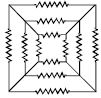
Twelve resistors each of resistance $16 \,\Omega $ are connected in the circuit as shown. The net resistance between $AB$ (any two conjugate points of outer square) is ............... $\Omega$
An antenna is placed in a dielectric medium of dielectric constant $6.25$. If the maximum size of that antenna is $5.0\, mm$. it can radiate a signal of minimum frequency of $GHz .$

(Given $\mu_{ r }=1$ for dielectric medium)
A one metre long (both ends open) organ pipe is kept in a gas that has double the density of air at $STP$. Assuming the speed of sound in air at $STP$ is $300\; \mathrm{m} / \mathrm{s}$, the frequency difference between the fundamental and second harmonic of this pipe is ___ $\mathrm{Hz}$
Which of the following dimensions will be the same as that of time?
Which of the following theories is the most satisfactory about the origin of the universe
A vehicle is moving with a velocity $v$  on a curved road of width $b$  and radius of curvature $R.$  For counteracting the centrifugal force on the vehicle, the difference in elevation required in between the outer and inner edges of the road is
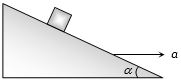
A block is kept on a frictionless inclined surface with angle of inclination '$\alpha$'. The incline is given an acceleration $ 'a'$ to keep the block stationary. Then a is equal to
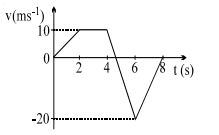
The figure shows a velocity-time graph of a particle moving along a straight line  The correct acceleration-time graph of the particle is shown as