Question
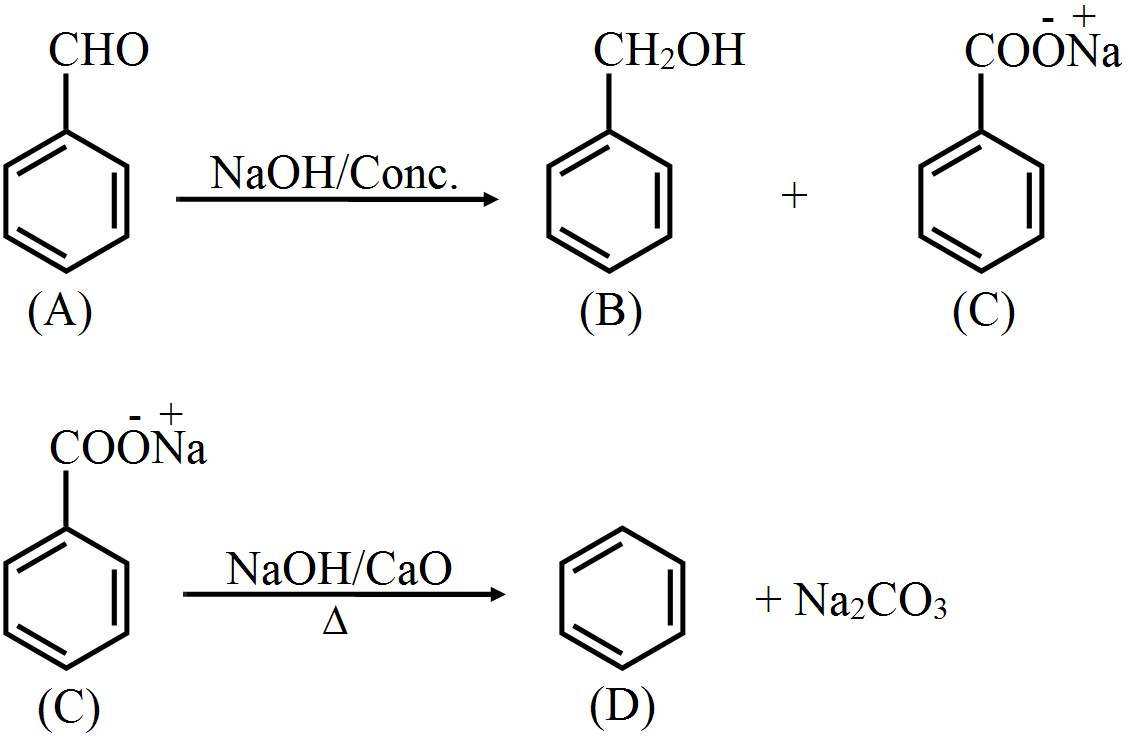
An organic compound (A) has characteristic odour. On treatment with NaOH, it forms compounds (B) and (C). Compound (B) has molecular formula $C_7H_8O$ which on oxidation gives back (A). The compound (C) is a sodium salt of an acid. When (C) is treated with soda-lime, it yields an aromatic compound (D). Deduce the structures of (A), (B), (C) and (D). Write the sequence of reactions involved.
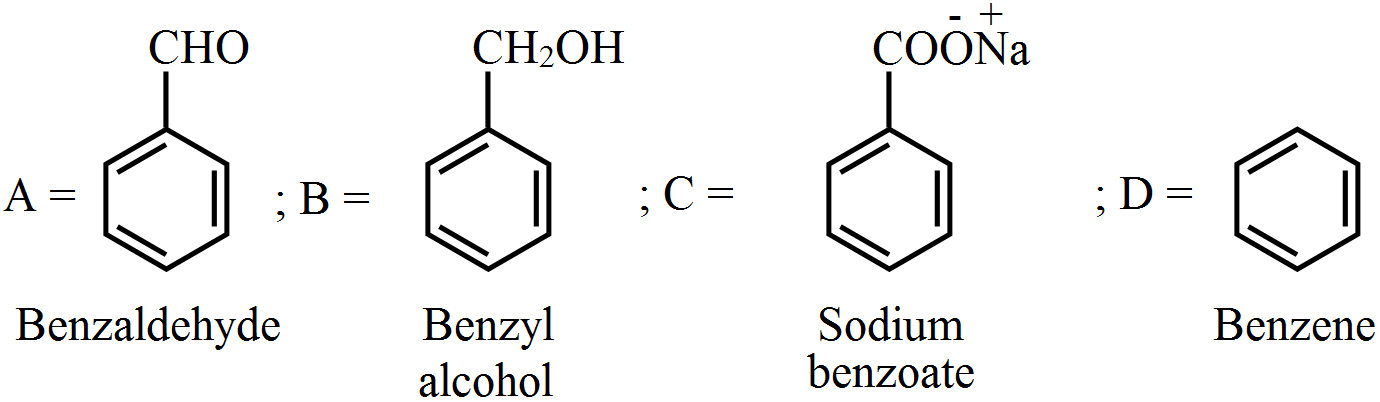
Answer


Reaction involved are:

Need a full question paper?

Generate a complete, print-ready paper with questions like this in minutes — across 16+ boards, with answer keys.

Start Generating Free

Similar questions

Explain the effect of hydrogen bond on boiling point of alcohol and phenol.
Explain chemical properties of $KMnO _4$
How would you bring about the following conversions?
i. Propanal to butanone
ii. Benzaldehyde to benzophenone
iii. Benzoyl chloride to benzonitrile
  1. Using valence bond theory predict the geometry and magnetic behaviour of $[Cr(NH_3)_6]^{3+}ion[Cr=24].$
  2. Write IUPAC name of:
$[Pt(NH_3)_2Cl_2].$
For a reaction $\text{A + B}\xrightarrow{\ \ \ \ \ }\text{Products},$ the rate law is - $\text{Rate}=\text{k}[\text{A}][\text{B}]^\frac{3}{2}$ Can the reaction be an elementary reaction? Explain.
Discuss the method to determine electrode potential of copper and zine by using standard hydrogen electrode.
For a first order reaction, show that time required for $99\%$ completion is twice the time required for the completion of $90\%$ of reaction.
Estimate the minimum potential difference needed to reduce $Al_2O_3$ at $500°C$. The free energy change for the decomposition reaction,
$\frac{2}{3}\text{Al}_2\text{O}_3\frac{4}{3}\text{Al + O}_2\text{ is }960\text{kJ (F = 96500C mol}-1)$
Calculate the emf of the cell $Mg ( s )\left| Mg ^{+2}(0.1 M )\right| \mid Cu ^{+2}\left(1 \times 10^{-3} M \mid Cu ( s )\right)$ Given, $\left.E _{C u^{2+} / C u}^{\ominus}=+0.34 V, E _{M g^{+2} / M g}^{\ominus}=-2.37 V\right)$
For the reaction:
$2 A+B \rightarrow A_2 B$
the rate $= k [ A ][ B ]^2$ with $k =2.0 \times 10^{-6} mol^{-2} L^2 s^{-1}$. Calculate the initial rate of the reaction when $[ A ]=0.1 mol$ $L ^{-1},[B]=0.2 mol L ^{-1}$. Calculate the rate of reaction after $[ A ]$ is reduced to $0.06 mol L ^{-1}$.