MCQ
An uniform thick string of length $8\, m$ is resting on a horizontal frictionless surface. It is pulled by a horizontal force of $8\, N$ from one end. The tension in the string at $3\, m$ from the force applied is ........ $N$
  • A
    $0$
  • $5$
  • C
    $4$
  • D
    $1$

Answer

Correct option: B.
$5$
b
Let the mass of the string is $M$

acceleration of the string $=\frac{8}{\mathrm{M}}$

$8-\mathrm{T}=\left(\frac{3 \mathrm{M}}{8}\right) \times \frac{8}{\mathrm{M}} \Rightarrow \mathrm{T}=5 \mathrm{N}$

Need a full question paper?

Generate a complete, print-ready paper with questions like this in minutes — across 16+ boards, with answer keys.

Start Generating Free

Similar questions

A bowl filled with very hot soup cools from $98^{\circ}\,C$ to $86^{\circ}\,C$ in $2$ minutes when the room temperature is $22^{\circ}\,C$. $..........\,minutes$ long it will take to cool from $75^{\circ}\,C$ to $69^{\circ}\,C$ ?
A ball is thrown vertically up ward. It has a speed of $10\;m/sec$ when it has reached one half of its maximum height. How high ($m$ માં) does the ball rise? (Take $g = 10 \;m/s^2$)
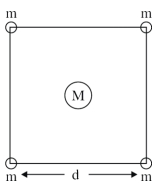
Four spheres each of mass $m$ form a square of side $d$ (as shown in figure). A fifth sphere of mass $M$ is situated at the centre of square. The total gravitational potential energy of the system is
The horizontal range of a projectile fired at an angle of 15° is 50m. If it is fired with the same speed at an angle of 45°, its range will be
  1. 60m
  2. 71m
  3. 100m
  4. 141m
A body of mass $m$ moving with a constant velocity $v$ hits another body of the same mass moving with the same velocity $v$ but in the opposite direction and sticks to it. The velocity of the compound body after collision is
Two walls of thicknesses $d_1$ and $d_2$ and thermal conductivities $k_1$ and $k_2$ are in contact. In the steady state, if the temperatures at the outer surfaces are ${T_1}$ and ${T_2}$, the temperature at the common wall is
The position vector of three particles of masses $1\, kg, 2\, kg$ and $3\, kg$ are $\overrightarrow {{r_1}}  = (\widehat i + 4\widehat j + \widehat k)\,m,\overrightarrow {{r_2}}  = (\widehat i + \widehat j + \widehat k)\,m$ and $\overrightarrow {{r_3}}  = (2\widehat i - \widehat j - 2\widehat k)\,m$  respectively. The position  vector of their centre of mass is
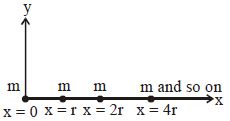
Consider an infinite distribution of point masses (each of mass $m$) placed on $x$ -axis  as shown in the diagram. What is the gravitational force acting on the point mass  placed at the origin ?
A plane progressive wave is represented by the equation $y = 0.1\sin \left( {200\pi t - \frac{{20\pi x}}{{17}}} \right)$ where y is displacement in $m$, $ t$ in second and $x$ is distance from a fixed origin in meter. The frequency, wavelength and speed of the wave respectively are
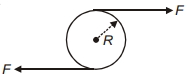
Two equal and opposite forces are applied tangentially to a uniform disc of mass $M$ and radius $R$ as shown in the figure. If the disc is pivoted at its centre and free to rotate in its plane, the angular acceleration of the disc is ............