MCQ
An unpolarized light passes through three polarizing sheets whose polariging directions make an angle of $30^o$ , $60^o$ and $30^o$ with $y$ axis in same sense. What fraction of initial intensity is transmitted by the system ?
  • A
    $\frac {1}{2}$
  • $\frac {9}{32}$
  • C
    $\frac {3}{32}$
  • D
    $\frac {9}{64}$

Answer

Correct option: B.
$\frac {9}{32}$
b
$I = \frac{{{I_0}}}{2} \times {\cos ^2}{30^o} \times {\cos ^2}{30^o}$

= $\frac {9I_0}{32}$

Need a full question paper?

Generate a complete, print-ready paper with questions like this in minutes — across 16+ boards, with answer keys.

Start Generating Free

Similar questions

The focal lengths of the objective and eye lenses of a telescope are respectively $200 \,cm$ and $5 \,cm.$ The maximum magnifying power of the telescope will be
In Young’s experiment, the distance between slits is $0.28 \,mm$ and distance between slits and screen is $1.4 \,m.$ Distance between central bright fringe and third bright fringe is $0.9 \,cm$. What is the wavelength of used light....$\mathop A\limits^o $
The wavelength of light visible to eye is of the order of
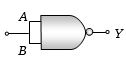
This symbol represents
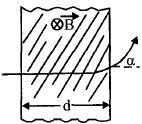
A proton (mass $m$ ) accelerated by a potential difference $V$  flies through a uniform transverse magnetic field $B.$ The field occupies a region of space by width $'d'$. If $\alpha $ be the angle of deviation of proton from initial direction of motion (see figure), the value of $sin\,\alpha $ will be
A prism of angle $A=1^{\circ}$ has a refractive index $\mu=1.5 .$ A good estimate for the minimum angle of deviation (in degrees) is close to $N/10$ Value of $N$ is......
A galvanometer of resistance $50\, \Omega$ is connected to a battery of $3\, V$ along with a resistance of $2950\, \Omega$ in series. A full scale deflection of $30$ divisions is obtained in the galvanometer. In order to reduce this deflection to $20$ divisions, the resistance in series should be.......$Ω$
The average kinetic energy of a gas molecule can be determined by knowing
If energy of electron in ground state is $-13.6$ then find out speed of electron in fourth orbit of $H-$atom
Amount of light entering into the camera depends upon